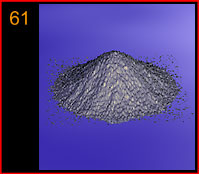
The sixty first element of the periodic table
The promethium (named after the Greek titan Prometheus) is a chemical element of symbol Pm and of atomic number 61 (61 protons and 61 electrons), and atomic mass 145 u. At room temperature, the promethium is in a solid state. It is part of the rare earth group.
The main application is as beta radiation emitter to produce thickness gauges. Proof of the existence of the prometium was only obtained in 1945 by Jacob A. Marinsky, Lawrence E. Glendenin and Charles D. Coryell during the analysis of uranium fission by-products.
History:
The existence of the prophecy was first predicted by Bohuslav Brauner in 1902; This prediction was confirmed by Henry Moseley in 1914. Several groups claimed to have produced the element, but could not confirm their findings because of the difficulty of separating the promethium from other elements. Proof of the existence of the prometium was only obtained in 1945 by Jacob A. Marinsky, Lawrence E. Glendenin and Charles D. Coryell during the analysis of uranium fission by-products. However, too busy with research on defense projects during World War II, they did not announce the discovery until 1947.
The prometium name for the element is derived from Prometheus of Greek mythology, who stole the fire from heaven and gave it to mankind.
In 1963, ion exchange chromatography methods were used to prepare approximately 10 grams of promethium from nuclear fission fission tailings.
Currently, promethium is still recovered from the uranium fission by-products, but it can also be produced by bombarding 146Nd with neutrons, yielding 147Nd that decays at 147Pm through an 11-day beta half-life decay.
It was the last of the rare earth elements discovered.
Main Features: The promethium is a light emitter of beta particles, but does not emit gamma radiation. However, X-ray emission may occur when beta particles reach elements with higher atomic numbers. Little is known about the chemical and physical properties of the metallic promethium, but they are similar to neodymium and samarium. The promethium has two allotropic varieties.
Salts of this metal show luminescence in the dark with a pale blue or gray glow due to their high radioactivity.
Applications
As a source of beta radiation to produce very thin thickness gauges. Beta radiation on phosphorus generates light. This light, through photocells, can be used to produce very small batteries that convert light into electric current, with a useful life of approximately 5 years using 147-Pm for space research. their luminescent salts can be used for the production of hands and watch faces.
In the future, possibly as a portable X-ray and heat source for use in space probes, artificial satellites, medical applications, and for the production of lasers for submarine communication when submerged.
Occurrence:
The promethium is not found naturally on earth, but has been identified on the HR465 star spectrum in the Andromeda constellation, and possibly on HD 101065 (Przybylski star) and HD 965.2.
The main application is as beta radiation emitter to produce thickness gauges. Proof of the existence of the prometium was only obtained in 1945 by Jacob A. Marinsky, Lawrence E. Glendenin and Charles D. Coryell during the analysis of uranium fission by-products.
History:
The existence of the prophecy was first predicted by Bohuslav Brauner in 1902; This prediction was confirmed by Henry Moseley in 1914. Several groups claimed to have produced the element, but could not confirm their findings because of the difficulty of separating the promethium from other elements. Proof of the existence of the prometium was only obtained in 1945 by Jacob A. Marinsky, Lawrence E. Glendenin and Charles D. Coryell during the analysis of uranium fission by-products. However, too busy with research on defense projects during World War II, they did not announce the discovery until 1947.
The prometium name for the element is derived from Prometheus of Greek mythology, who stole the fire from heaven and gave it to mankind.
In 1963, ion exchange chromatography methods were used to prepare approximately 10 grams of promethium from nuclear fission fission tailings.
Currently, promethium is still recovered from the uranium fission by-products, but it can also be produced by bombarding 146Nd with neutrons, yielding 147Nd that decays at 147Pm through an 11-day beta half-life decay.
It was the last of the rare earth elements discovered.
Main Features: The promethium is a light emitter of beta particles, but does not emit gamma radiation. However, X-ray emission may occur when beta particles reach elements with higher atomic numbers. Little is known about the chemical and physical properties of the metallic promethium, but they are similar to neodymium and samarium. The promethium has two allotropic varieties.
Salts of this metal show luminescence in the dark with a pale blue or gray glow due to their high radioactivity.
Applications
As a source of beta radiation to produce very thin thickness gauges. Beta radiation on phosphorus generates light. This light, through photocells, can be used to produce very small batteries that convert light into electric current, with a useful life of approximately 5 years using 147-Pm for space research. their luminescent salts can be used for the production of hands and watch faces.
In the future, possibly as a portable X-ray and heat source for use in space probes, artificial satellites, medical applications, and for the production of lasers for submarine communication when submerged.
Occurrence:
The promethium is not found naturally on earth, but has been identified on the HR465 star spectrum in the Andromeda constellation, and possibly on HD 101065 (Przybylski star) and HD 965.2.