Neodymium sixtieth element of the Periodic Table
The neodymium (gr. Neo, nova, dydimos, twin) is a chemical element of symbol Nd and of atomic number 60 (60 protons and 60 electrons), and atomic mass 144.2 u. At room temperature, the neodymium is in the solid state. It is part of the rare earth group.
History:
Neodymium was discovered by Baron Carl Auer von Welsbach, an Austrian chemist, in Vienna in 1885. It separated neodymium, as well as the praseodymium element, from a material known as didymium by spectroscopic analysis. However, this metal was not isolated in shape relatively before 1925. The name neodymium is derived from the new Greek "neos" and "didymos" twin.
Neodymium is currently obtained by an ion exchange process of monazite sand ((Ce, La, Th, Nd, Y) PO4), a material rich in rare earth elements, and by electrolysis of its halide salts.
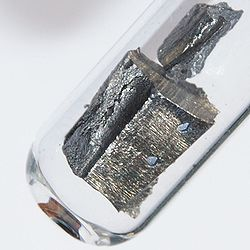
Main Features: Neodymium represents about 18% of the rare earth group metals. The metal has a metallic, silver, shiny sheen; however, being one of the most reactive rare earth metals, neodymium dims rapidly in the air to form an oxide, which chipped exposes the metal to further oxidation.
Applications:
Neodymium is a component of didymium, which is used to color glass and make goggles because it absorbs yellow flame light for glass welders and blowers.
Neodymium gives delicate colors to glasses ranging from pure violet, wine to light gray. The light transmitted through these glasses has a narrow and well defined absorption band. These crystals are used by astronomers to calibrate devices called infrared spectrometers and filters. Neodymium is also used to remove the green color caused by the contaminating iron from the glass.
Some types of glass containing neodymium are used to produce synthetic rubies used in lasers. Certain materials may contain small concentrations of neodymium ions that can be used in infrared radiation lasers (1054 - 1064 nm). Some Nd lasers are, for example, Nd: YAG (Yttrium Aluminum Crystal) used in dentistry and medicine, Nd: YLF (Yttrium Lithium Fluoride), Nd: YVO (Yttrium Vanadate), and others.
Neodymium salts are used as enamel dyes. Neodymium is used in very powerful Nd2Fe14B permanent magnets. These magnets are cheaper than samarium-cobalt magnets, and are common in products such as headphones, speakers, computer hard drives, motor starters, sensors, and so on.
Probably due to its similarity to Ca2 +, Nd3 + was disclosed1 as an element to promote plant growth. Rare earth element compounds are often used in China as fertilizers.
Occurrence:
Neodymium is never found in nature as a free element. Occurs in ores such as monazite ((Ce, La, Th, Nd, Y) PO4) and bastnasite ((Ce, La, Th, Nd, Y) (CO3) F) sand, which have small amounts in their composition of all rare earth metals. It is difficult to separate it from other rare earth elements.
History:
Neodymium was discovered by Baron Carl Auer von Welsbach, an Austrian chemist, in Vienna in 1885. It separated neodymium, as well as the praseodymium element, from a material known as didymium by spectroscopic analysis. However, this metal was not isolated in shape relatively before 1925. The name neodymium is derived from the new Greek "neos" and "didymos" twin.
Neodymium is currently obtained by an ion exchange process of monazite sand ((Ce, La, Th, Nd, Y) PO4), a material rich in rare earth elements, and by electrolysis of its halide salts.
Main Features: Neodymium represents about 18% of the rare earth group metals. The metal has a metallic, silver, shiny sheen; however, being one of the most reactive rare earth metals, neodymium dims rapidly in the air to form an oxide, which chipped exposes the metal to further oxidation.
Applications:
Neodymium is a component of didymium, which is used to color glass and make goggles because it absorbs yellow flame light for glass welders and blowers.
Neodymium gives delicate colors to glasses ranging from pure violet, wine to light gray. The light transmitted through these glasses has a narrow and well defined absorption band. These crystals are used by astronomers to calibrate devices called infrared spectrometers and filters. Neodymium is also used to remove the green color caused by the contaminating iron from the glass.
Some types of glass containing neodymium are used to produce synthetic rubies used in lasers. Certain materials may contain small concentrations of neodymium ions that can be used in infrared radiation lasers (1054 - 1064 nm). Some Nd lasers are, for example, Nd: YAG (Yttrium Aluminum Crystal) used in dentistry and medicine, Nd: YLF (Yttrium Lithium Fluoride), Nd: YVO (Yttrium Vanadate), and others.
Neodymium salts are used as enamel dyes. Neodymium is used in very powerful Nd2Fe14B permanent magnets. These magnets are cheaper than samarium-cobalt magnets, and are common in products such as headphones, speakers, computer hard drives, motor starters, sensors, and so on.
Probably due to its similarity to Ca2 +, Nd3 + was disclosed1 as an element to promote plant growth. Rare earth element compounds are often used in China as fertilizers.
Occurrence:
Neodymium is never found in nature as a free element. Occurs in ores such as monazite ((Ce, La, Th, Nd, Y) PO4) and bastnasite ((Ce, La, Th, Nd, Y) (CO3) F) sand, which have small amounts in their composition of all rare earth metals. It is difficult to separate it from other rare earth elements.