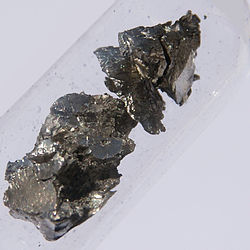
Praseodymium Fifty-ninth Element of the Periodic Table
Praseodymium (from the Greek prasios, "green", and didymos, "twin") is a chemical element of symbol Pr and atomic number 59 (59 protons and 59 electrons) with atomic mass 140,9 u which at room temperature is at solid state. It is part of the rare earth group, naturally occurring in the monazite and bastnasite minerals. It was isolated in 1885 by the Austrian chemist Baron Carl Auer von Welsbach from the didymium.
Praseodymium is used to produce high thermal and mechanical strength alloys used in aircraft engine and filament components for cinematographic projector lamps. It is also used in the production of Misch metal for lighter stones.
History
The name praseodymium comes from the Greek prasios ("green") and didymos ("twin"). In 1841, Mosander extracted the rare "didymium" from Lantana. In 1874 Per Teodor Cleve concluded that didymium was, in fact, a mixture of two different elements. In 1879, Lecoq de Boisbaudran isolated a new rare samarium land from the didymium obtained from the Samarskite mineral. In 1885, the Austrian chemist Baron C. F. Auer von Welsbach separated from the didymium two chemical elements, praseodymium and neodymium, whose salts have different colors. The metallic element was isolated relatively pure in 1931.
Main Features: Praseodymium is a soft, silver metallic element belonging to lanthanides. It is more resistant to corrosion in the air than europium, lanthanum, cerium or neodymium, but develops a green oxide that coats the metal when exposed to air, further exposing the metal to oxidation. For this reason, praseodymium should be stored immersed in mineral oil or sealed in plastic or glass.
Applications:
In addition with magnesium to produce high strength metal alloys used in aircraft engines.
Praseodymium is used as a core in the carbon arc lamps for the film industry for studio and projector lighting. They make up Misch metal in the amount of 5% for the production of lighter ignition stones.
Praseodymium compounds are used to color glasses and enamels in yellow. Praseodymium is a component of didymium, used in glasses to make goggles.
Occurrence:
Praseodymium is found in rare earth minerals such as monazite and bastnasite. Praseodymium can be recovered from monazite or bastnasite by the ion exchange process. Praseodymium is also a component, around 5%, of Misch metal.
The most important monazite deposits are found in the United States (Idaho-Montana and Florida), Brazil, Australia, South Africa and India. Bastnasite is mainly found in California (United States).
Praseodymium is used to produce high thermal and mechanical strength alloys used in aircraft engine and filament components for cinematographic projector lamps. It is also used in the production of Misch metal for lighter stones.
History
The name praseodymium comes from the Greek prasios ("green") and didymos ("twin"). In 1841, Mosander extracted the rare "didymium" from Lantana. In 1874 Per Teodor Cleve concluded that didymium was, in fact, a mixture of two different elements. In 1879, Lecoq de Boisbaudran isolated a new rare samarium land from the didymium obtained from the Samarskite mineral. In 1885, the Austrian chemist Baron C. F. Auer von Welsbach separated from the didymium two chemical elements, praseodymium and neodymium, whose salts have different colors. The metallic element was isolated relatively pure in 1931.
Main Features: Praseodymium is a soft, silver metallic element belonging to lanthanides. It is more resistant to corrosion in the air than europium, lanthanum, cerium or neodymium, but develops a green oxide that coats the metal when exposed to air, further exposing the metal to oxidation. For this reason, praseodymium should be stored immersed in mineral oil or sealed in plastic or glass.
Applications:
In addition with magnesium to produce high strength metal alloys used in aircraft engines.
Praseodymium is used as a core in the carbon arc lamps for the film industry for studio and projector lighting. They make up Misch metal in the amount of 5% for the production of lighter ignition stones.
Praseodymium compounds are used to color glasses and enamels in yellow. Praseodymium is a component of didymium, used in glasses to make goggles.
Occurrence:
Praseodymium is found in rare earth minerals such as monazite and bastnasite. Praseodymium can be recovered from monazite or bastnasite by the ion exchange process. Praseodymium is also a component, around 5%, of Misch metal.
The most important monazite deposits are found in the United States (Idaho-Montana and Florida), Brazil, Australia, South Africa and India. Bastnasite is mainly found in California (United States).