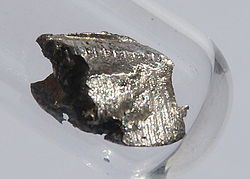
Cerium Fifty-eighth Element of the Periodic Table
Cerium (from the Latin "cerium" named after the asteroid Ceres) is a chemical element of the Ce symbol, atomic number 58 (58 protons and 58 electrons) with atomic mass 140.1 u. It is a metallic element of the internal transition series (rare earth, lanthanide) found mainly in the monazite and bastnasite minerals. At room temperature cerium is in a solid state.
It is mainly used in the form of alloys for the production of lighter ignition stones and graphite arc electrodes in the film industry. Its oxide is used as a catalyst in self-cleaning furnaces and in the oil industry. Its sulphate is a strong oxidizing agent used in volumetric chemical analysis. It was discovered in 1803 by the Swedish Jöns Jacob Berzelius.
History:
Cerium was discovered in Sweden by Jöns Jacob Berzelius and Wilhelm von Hisinger, and independently in Germany by Martin Heinrich Klaproth, both in 1803. Cerium was named after Berzelius after the Ceres asteroid discovered two years earlier (1801). Metal was isolated in 1875 by Norton and Hillebrand.
Main Features: Cerium is a silver metallic element, belonging to the chemical series internal transition (rare earth, lanthanide). It is used in some rare earth alloys. It resembles iron in color and luster, but is soft, pliable and ductile. Loses the luster quickly in the presence of air.
Only the europium is more reactive among the rare earth elements. Alkaline solutions and dilute and concentrated acids attack the metal rapidly. Pure metal may ignite when scratched with a knife. Cerium reacts slowly in cold water and rapidly in hot water.
Due to the electronic distribution at the 4f sublevel and other outer orbitals, cerium exhibits interesting chemical characteristics. For example, compression or cooling of the metal may modify its oxidation state from +3 to +4.
Cerium with +3 oxidation state is called 'waxy' when it has +4 oxidation state of 'ceric'.
Cerium IV (ceric) salts are red, orange or yellow, and cerium III (waxy) salts are generally white.
Applications:
In metallurgy:
It is used for the production of aluminum alloys, steels and irons. Add cerium to cast iron to produce malleable iron. In steel cerium can help reduce sulfates and oxides. Cerium is used in stainless steel as a hardening agent. 3 to 4% cerium is added to magnesium alloys to give heat resistance. Cerium is used in alloys that are used for the production of permanent magnets. Cerium is a component of pyrophosphoric alloys used for the production of
lighter stones.
Cerium Oxide
The oxide was used in gas lamp blankets. Oxide is emerging as a hydrocarbon catalyst in self-cleaning furnaces,
embedded in the furnace walls. Cerium oxide is used as an abrasive in the glass polishing industry. Cerium oxide is finding use as a catalyst in oil cracking and refining
Cerium is used in carbon arc lamps, mainly in the film industry. Cereic sulphate is used extensively as an oxidizing agent in volumetric quantitative analyzes :( volumetric titration). Cerium compounds are used in the manufacture of glass as both a component and a bleach. Cerium compounds are used for enamel coloring In glass, cerium oxide allows the absorption of ultraviolet light. Cerium III and cerium IV compounds are used to catalyze organic syntheses. It is used as a component of the latest generation gamma camera scintillation crystal in nuclear medicine.
Occurrence:
Cerium is the most abundant among rare earth elements, making up approximately 0.0046% of the earth's crust. It is found in various minerals including alanite (orthite - (Ca, Ce, La, Y) 2 (Al, Faith) 3 (SiO4) 3 (OH), monazite (Ce, La, Th, Nd, Y) PO4, bastnasite (Ce, La, Y) CO3F, hydroxylbastnasite (Ce, La, Nd) CO3 (OH, F), Rabdophan (Ce, La, Nd) PO4-H2O, and Ca (Ce, La, Nd, Y) (CO3) ) 2F Monazite and bastnasite are currently the two most important sources of cerium.
Cerium is usually prepared through an ion exchange process that uses monazite sands as cerium sources. Large deposits of monazite, alanite and bastnasite will provide cerium, thorium and other rare earth metals for many years.
The most important monazite sands deposits are found in the United States (Idaho-Montana and Florida), Brazil (Espirito Santo and Catalan-Ombudsman), Australia, South Africa and India. Bastnasite is mainly found in California (United States).
It is mainly used in the form of alloys for the production of lighter ignition stones and graphite arc electrodes in the film industry. Its oxide is used as a catalyst in self-cleaning furnaces and in the oil industry. Its sulphate is a strong oxidizing agent used in volumetric chemical analysis. It was discovered in 1803 by the Swedish Jöns Jacob Berzelius.
History:
Cerium was discovered in Sweden by Jöns Jacob Berzelius and Wilhelm von Hisinger, and independently in Germany by Martin Heinrich Klaproth, both in 1803. Cerium was named after Berzelius after the Ceres asteroid discovered two years earlier (1801). Metal was isolated in 1875 by Norton and Hillebrand.
Main Features: Cerium is a silver metallic element, belonging to the chemical series internal transition (rare earth, lanthanide). It is used in some rare earth alloys. It resembles iron in color and luster, but is soft, pliable and ductile. Loses the luster quickly in the presence of air.
Only the europium is more reactive among the rare earth elements. Alkaline solutions and dilute and concentrated acids attack the metal rapidly. Pure metal may ignite when scratched with a knife. Cerium reacts slowly in cold water and rapidly in hot water.
Due to the electronic distribution at the 4f sublevel and other outer orbitals, cerium exhibits interesting chemical characteristics. For example, compression or cooling of the metal may modify its oxidation state from +3 to +4.
Cerium with +3 oxidation state is called 'waxy' when it has +4 oxidation state of 'ceric'.
Cerium IV (ceric) salts are red, orange or yellow, and cerium III (waxy) salts are generally white.
Applications:
In metallurgy:
It is used for the production of aluminum alloys, steels and irons. Add cerium to cast iron to produce malleable iron. In steel cerium can help reduce sulfates and oxides. Cerium is used in stainless steel as a hardening agent. 3 to 4% cerium is added to magnesium alloys to give heat resistance. Cerium is used in alloys that are used for the production of permanent magnets. Cerium is a component of pyrophosphoric alloys used for the production of
lighter stones.
Cerium Oxide
The oxide was used in gas lamp blankets. Oxide is emerging as a hydrocarbon catalyst in self-cleaning furnaces,
embedded in the furnace walls. Cerium oxide is used as an abrasive in the glass polishing industry. Cerium oxide is finding use as a catalyst in oil cracking and refining
Cerium is used in carbon arc lamps, mainly in the film industry. Cereic sulphate is used extensively as an oxidizing agent in volumetric quantitative analyzes :( volumetric titration). Cerium compounds are used in the manufacture of glass as both a component and a bleach. Cerium compounds are used for enamel coloring In glass, cerium oxide allows the absorption of ultraviolet light. Cerium III and cerium IV compounds are used to catalyze organic syntheses. It is used as a component of the latest generation gamma camera scintillation crystal in nuclear medicine.
Occurrence:
Cerium is the most abundant among rare earth elements, making up approximately 0.0046% of the earth's crust. It is found in various minerals including alanite (orthite - (Ca, Ce, La, Y) 2 (Al, Faith) 3 (SiO4) 3 (OH), monazite (Ce, La, Th, Nd, Y) PO4, bastnasite (Ce, La, Y) CO3F, hydroxylbastnasite (Ce, La, Nd) CO3 (OH, F), Rabdophan (Ce, La, Nd) PO4-H2O, and Ca (Ce, La, Nd, Y) (CO3) ) 2F Monazite and bastnasite are currently the two most important sources of cerium.
Cerium is usually prepared through an ion exchange process that uses monazite sands as cerium sources. Large deposits of monazite, alanite and bastnasite will provide cerium, thorium and other rare earth metals for many years.
The most important monazite sands deposits are found in the United States (Idaho-Montana and Florida), Brazil (Espirito Santo and Catalan-Ombudsman), Australia, South Africa and India. Bastnasite is mainly found in California (United States).