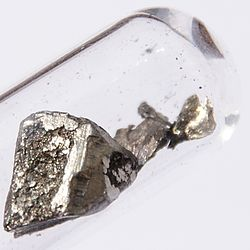
Lanthanum Fifty seventh Periodic Table element
Lanthanum is a chemical element of chemical symbol La of atomic number 57 (57 protons and 57 electrons), with atomic mass 138.9 u. It is an internal transition metal, lanthanide, rare earth, belonging to group 3 of the periodic classification of elements. At room temperature, the lanthanum is in the solid state.
It is mainly found in rare earth minerals associated with cerium. It is ductile and malleable mainly used in alloys for the production of special lenses, lighter stones and as a hydrogen sponge. It was discovered in 1839 by Carl Gustaf Mosander in Stockholm, Sweden.
History:
Lanthanum was discovered in 1839 by Carl Gustaf Mosander, Stockholm, Sweden. From the partial decomposition of a sample of cerium nitrate by heating and treating the salt with dilute nitric acid. From the resulting solution, it isolated a new rare earth, which it termed "lantana". Lanthanum was isolated in relatively pure form in 1923. The word lanthanum comes from the Greek lanthanein, which means "hidden."
The metal is pyrophoric, so it is used in alloys (25% to 45%) for the production of lighter stones. Oxide is used in electronics: electronic valves Lanthanum alloys like hydrogen sponges. These alloys are capable of absorbing up to 400 times their volume of gaseous hydrogen, and it is a reversible process.
As a catalyst in the cracking of petroleum (transformation of crude oil into its derivatives). Gas lantern blankets. In the form of compounds it is used to polish glasses and in lapidation. La-barium in rocks and ore dating. Lanthanum nitrate is mainly applied in special glasses, water treatment and as a catalyst.
The element is not absorbed orally and, when injected, its elimination is very slow. Lanthanum carbonate is being studied as a compound to absorb phosphate in cases of renal failure. Some rare earth chlorides, such as lanthanum chloride (LaCl 3), are known to have anticoagulant properties.
Occurrence:
Monazite (Ce + La + Th + Nd + Y) PO4, and bastnasite (Ce + La + Y) CO3F, are the main ores in which the lanthanum occurs in percentages 25% and 38%, respectively.
The major monazite deposits are found in India, the United States, Brazil, South Africa and Australia. The major deposits of bastnasite are in the United States (California and New Mexico).
Other minerals containing lanthanum are cerite and alanite.
It is mainly found in rare earth minerals associated with cerium. It is ductile and malleable mainly used in alloys for the production of special lenses, lighter stones and as a hydrogen sponge. It was discovered in 1839 by Carl Gustaf Mosander in Stockholm, Sweden.
History:
Lanthanum was discovered in 1839 by Carl Gustaf Mosander, Stockholm, Sweden. From the partial decomposition of a sample of cerium nitrate by heating and treating the salt with dilute nitric acid. From the resulting solution, it isolated a new rare earth, which it termed "lantana". Lanthanum was isolated in relatively pure form in 1923. The word lanthanum comes from the Greek lanthanein, which means "hidden."
Main features:
Lanthanum is a silvery white metallic element belonging to group 3 of the periodic table and is often considered to be a lanthanide. Found in some minerals, usually in combination with cerium and other rare earth elements. Lanthanum is malleable, ductile, and soft enough to be cut with a knife. It is one of the most reactive among the rare earth elements. The metal reacts directly as the elements carbon, nitrogen, boron, selenium, silicon, phosphorus, sulfur, and with halogens. Oxidizes rapidly when exposed to air. Cold water slowly attacks the lanthanum, while hot water attacks much faster.Applications:
It is used in carbon electrodes for the production of light, mainly for studio lighting and projections in the film industry . La2O3 increases the strength of the glass, which are used for the production of special optical glasses, such as: Glass absorbent of infrared radiation. Optical lenses for cameras and telescopes due to high refractive index and low dispersion. LaB6 (Lanthanum Hexaboride) is used as an electron-emitting source in high-resolution electron microscopes. Small amounts of lanthanum are added to the steel to improve its malleability, ductility and impact resistance. Small amounts are added to the iron to produce nodular cast iron. Small amounts of lanthanum (0.2% to 5%) are added to molybdenum to decrease its hardness and sensitivity to temperature variations.The metal is pyrophoric, so it is used in alloys (25% to 45%) for the production of lighter stones. Oxide is used in electronics: electronic valves Lanthanum alloys like hydrogen sponges. These alloys are capable of absorbing up to 400 times their volume of gaseous hydrogen, and it is a reversible process.
As a catalyst in the cracking of petroleum (transformation of crude oil into its derivatives). Gas lantern blankets. In the form of compounds it is used to polish glasses and in lapidation. La-barium in rocks and ore dating. Lanthanum nitrate is mainly applied in special glasses, water treatment and as a catalyst.
Biological Functions:
Lanthanum has no known biological role. (lanthanum blocks the pore formed by alpha-latrotoxin in in vitro studies)The element is not absorbed orally and, when injected, its elimination is very slow. Lanthanum carbonate is being studied as a compound to absorb phosphate in cases of renal failure. Some rare earth chlorides, such as lanthanum chloride (LaCl 3), are known to have anticoagulant properties.
Occurrence:
Monazite (Ce + La + Th + Nd + Y) PO4, and bastnasite (Ce + La + Y) CO3F, are the main ores in which the lanthanum occurs in percentages 25% and 38%, respectively.
The major monazite deposits are found in India, the United States, Brazil, South Africa and Australia. The major deposits of bastnasite are in the United States (California and New Mexico).
Other minerals containing lanthanum are cerite and alanite.