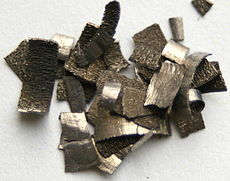
Dysprosium Sixty-sixth element of the Periodic Table
Dysprosium is a chemical element of symbol Dy and of atomic number 66 (66 protons and 66 electrons), with atomic mass 162,5 æ. At room temperature, dysprosium is in a solid state. It is part of the rare earth group.
Dysprosium is used in conjunction with vanadium and other elements as a component of laser materials.
This element was first identified in 1886 in Paris by the French chemist Paul Émile Lecoq de Boisbaudran.
History:
The dysprosium was first identified in 1886 in Paris by the French chemist Paul Émile Lecoq de Boisbaudran; however, the element was isolated in relatively pure form only after Spedding's development of ion exchange and metallographic reduction techniques in the 1950s. The name dysprosium is derived from the Greek dysprositos, which means difficult to achieve.
Key Features:
Dysprosium is a rare earth element that has a silver metallic sheen and is relatively stable in air at room temperature, but dissolves in dilute or concentrated hydrogen-releasing mineral acids, that is, oxidizing. It is soft enough to be cut with a knife, and can be processed with machines without sparking, preventing overheating. Dysprosium characteristics can be greatly affected by small amounts of impurities.
Applications:
Dysprosium is used in conjunction with vanadium and other elements as a component of laser materials. Its high effective thermal neutron absorption section and high melting point suggest its usefulness for use in nuclear control bars. A mixed oxide of dysprosium and nickel forms materials that absorb neutrons, do not contract, and do not dilate under prolonged neutron bombardment, so it is used for cooling bars in nuclear reactors. Some dysprosium and cadmium calcogens are sources of infrared radiation for the study of chemical reactions. Dysprosium is also used for the manufacture of compact discs.
Occurrence and obtaining: BR> Dysprosium is never found as a free element, but is found in many minerals, including xenotime, fergusonite, gadolinite, euxenite, polycrase, blomstrandine, monazite, and bastnasite, often with erbium, holmium, or other rare earth elements.
The main source of dysprosium is euxenite, but it is also obtained as a byproduct of monazite processing.
Dysprosium is used in conjunction with vanadium and other elements as a component of laser materials.
This element was first identified in 1886 in Paris by the French chemist Paul Émile Lecoq de Boisbaudran.
History:
The dysprosium was first identified in 1886 in Paris by the French chemist Paul Émile Lecoq de Boisbaudran; however, the element was isolated in relatively pure form only after Spedding's development of ion exchange and metallographic reduction techniques in the 1950s. The name dysprosium is derived from the Greek dysprositos, which means difficult to achieve.
Key Features:
Dysprosium is a rare earth element that has a silver metallic sheen and is relatively stable in air at room temperature, but dissolves in dilute or concentrated hydrogen-releasing mineral acids, that is, oxidizing. It is soft enough to be cut with a knife, and can be processed with machines without sparking, preventing overheating. Dysprosium characteristics can be greatly affected by small amounts of impurities.
Applications:
Dysprosium is used in conjunction with vanadium and other elements as a component of laser materials. Its high effective thermal neutron absorption section and high melting point suggest its usefulness for use in nuclear control bars. A mixed oxide of dysprosium and nickel forms materials that absorb neutrons, do not contract, and do not dilate under prolonged neutron bombardment, so it is used for cooling bars in nuclear reactors. Some dysprosium and cadmium calcogens are sources of infrared radiation for the study of chemical reactions. Dysprosium is also used for the manufacture of compact discs.
Occurrence and obtaining: BR> Dysprosium is never found as a free element, but is found in many minerals, including xenotime, fergusonite, gadolinite, euxenite, polycrase, blomstrandine, monazite, and bastnasite, often with erbium, holmium, or other rare earth elements.
The main source of dysprosium is euxenite, but it is also obtained as a byproduct of monazite processing.