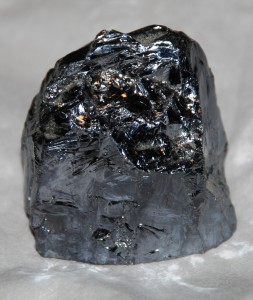
Silicon fourteenth element of the Periodic Table
Silicon, known to be used in integrated circuits (chips), is a relatively inert 4A family (semi-carbon) chemical element. It is solid, brittle, brown in amorphous form and dark gray with metallic luster in crystalline form. Its chemical symbol is Si.As a non-metallic element, it is poorly ductile or malleable. Its weighted atomic mass is 28u, and atomic number 14 (electrons and protons). It has +4 oxidation state as the most common, is semiconductor material and its crystalline arrangement resembles that of diamond.
Silicon is very resistant to acids, and few can oxidize it, such as the mixture of nitric acid and hydrofluoric acid. As well as being resistant to oxidation in the ambient atmosphere (it does not ignite simply by the presence of oxygen - but in a gaseous mixture with fluorine, for example) and to most chemical elements (except halogens and some metals). > Occurrence and Abundance:
Silicon is the second most abundant element on earth, constituting 27% of the earth's crust. However, if we consider the oxides of this metal, this value rises to 60%. It is present in a huge range of ores, including quartz, amethyst, agate, granite, feldspar and clay. Obtaining it requires temperatures in the thousands of degrees Celsius.
Silicon dioxide, silica, is one of the most important naturally occurring silicon compounds, emerging in three distinct crystalline forms: quartz, tridymite and cristobalite. Only quartz has commercial applicability and is very common in minerals such as granite, sand and sandstones. It is used to stabilize amplifier circuits, measure very high electrical potentials or to measure high instantaneous pressures. In addition, it can be used for optical experiment purposes.
World production of silicon is around 1 million tons per year, most of which is used in the production of silicones (fine chemicals) and special metal alloys.
Applications:
Electro-electronic Integrated Circuits; Alloys component; Photoelectric or photovoltaic cells (solar energy capture); Concretes and bricks; Refractory materials: ceramics, glass, cement; Synthesis of Silicones (varnishes, surgical prostheses, lubricants).
Fonts:
http://en.wikipedia.org/wiki/Silicon
http://www.tabela.oxigenio.com/nao_metais http://nautilus.fis.uc.pt/st2.5/