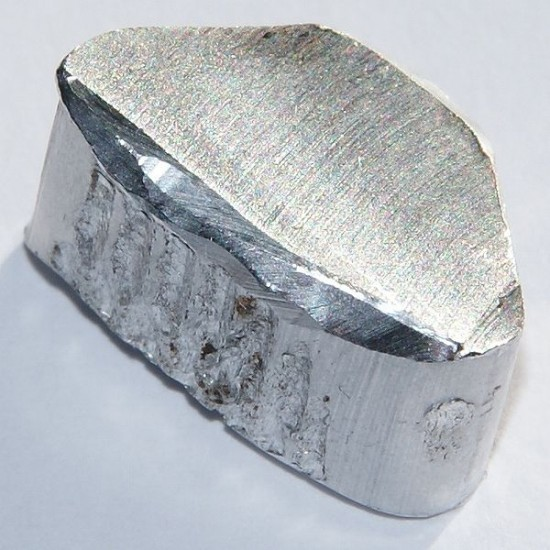
Aluminum Thirteenth Element of the Periodic Table
Aluminum (symbol Al) is a representative metal of atomic number 13 and weighted atomic mass 27 u. Because it is lightweight, relatively resistant and good conductor of heat and electricity, it is widely used in the production of consumer electronics (computers, audio and video devices), beverage cans (soft drinks, beers), as well as cooking utensils (pans, ice buckets). and “aluminum foil”).Under ambient conditions, it is solid and bright. And because it has a high affinity for oxygen (since it is a non-noble metal) it is not found pure in nature (despite being the most abundant metal in the earth's crust), but in the form of oxides and silicates. Its positive trivalence makes it highly oxidizable, so its visual appearance is matte gray; For its true shiny appearance to be seen, it is necessary to polish or rub it against another harder metal.
It is ductile and also the second most malleable metal - behind Gold only. The oxidation state +3 is practically the only one found in aluminum and the existence of solid hydroxides form the main component of bauxite mineral.
Occurrence
Impure aluminum constitutes about 8% of the earth's soil, and is in the form of cryolite (sodium aluminum fluorides), bauxite (aluminum hydroxides with clay) or granites and other silicate and oxygenated salts. Virtually all the aluminum produced comes from bauxite itself, as the other ores make the process more unfeasible, either due to scarcity or the difficulty of breaking chemical bonds, requiring high temperatures.
Even though bauxite is the easiest ore to obtain this metal, the transformation process requires a lot of energy, being the ratio 1: 14 000, that is, for every 1 ton of aluminum extracted, 14 000 KWH of energy is required. electric This removes the urgent need to recycle the aluminum already produced, as the energy demand is 95% lower, and it takes about 400 years to decompose in nature.
Reservations:
In 2001, the world had about 31.3 billion tons of bauxite reserves (Brazil accounted for more than 8 percent of this), of which 137 million tons were obtained in the same year. The amount of aluminum extracted, also in 2001, corresponds to 17% of total bauxite production. Among the producing countries, Brazil is in 3rd place, thanks to the North region - which holds 94% of all production. It is believed that bauxite will still be available for the next 200 years if the current rate of consumption is maintained.
Applications:
The applications of aluminum are very wide, as: in the firing of boats, airplanes and subways; in packaging (inner lining of paper boxes, aluminum foil, cans); civil construction (frames for doors, windows, bridges); metal alloys for high impact absorption; industrial boilers and cryogenic containers (at temperatures of -200 ° C).
Discovery:
Danish physicist and chemist: Hans Christian Oersted - Obtaining Alum (impure aluminum) in 1825; German pedagogue and chemist: Friedrich Wöhler - Obtaining isolated aluminum in 1827.
Read too: Recycling Aluminum Cans Sources: THEODORE L. Brown, H. EUGENE LeMay, BRUCE E. Bursten. Chemistry: The Central Science, São Paulo - SP: Prentice-Hall Publisher, 2005. 9th Edition. 992 pages http://www.dnpm-pe.gov.br/Details/Aluminio.htm (accessed 15/02/2010) http://en.wikipedia.org/wiki/Bauxita (accessed 15/02/2010) http://en.wikipedia.org/wiki/Aluminium (accessed 15/02/2010) http://mundoestranho.abril.com.br/geografia/pergunta_292573.shtml (accessed 15/02/2010) http://nautilus.fis.uc.pt/st2.5/scenes-p/elem/e01300.html (accessed 15/02/2010) http://www.tabela.oxigenio.com/other_metals/element_quimico_aluminio.htm (accessed 15/02/2010)