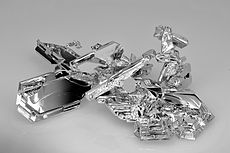
Ruthenium Forty-fourth Element of the Periodic Table
Ruthenium PB or ruthenium PE (Latin Ruthenia, which means "Russia") is a chemical element of symbol Ru of atomic number 44 (44 protons and 44 electrons) and atomic mass equal to 101 u. At room temperature, ruthenium is in the solid state. It is an element of the gold group (8 or 8b) of the periodic classification of the elements. It is a transition metal, not abundant, usually found in platinum mines. It is used as a catalyst and in high strength metal alloys with platinum or palladium. Ruthenium was discovered by Karl Klaus in 1844.
History:
Ruthenium was discovered by Karl Klaus in 1844 who noted that ruthenium oxide contained a new metal, obtaining 6 grams of ruthenium from the part of platinum that is insoluble in royal water.1 Jöns Berzelius and Gottfried Osann almost discovered it in 1827. They examined waste derived from the dissolution of a platinum sample from the Urals with royal water. Osann thought he had found three new metals, giving them names, one of them being ruthenium.
Polish chemist Jedrzej Sniadecki may have isolated this element in 1807, but this feat was not confirmed and he withdrew his request.1 Sniadecki had called this element vestium.1
Key Features:
It is a white, hard and brittle metal that has four different crystalline forms. It dissolves in molten bases and is not attacked by acids at room temperature. At high temperatures it reacts with halogens and hydroxides. Palladium and platinum hardness can be increased with small amounts of ruthenium. Also, the addition of small amounts significantly increases the corrosion resistance of titanium. A superconducting ruthenium and molybdenum alloy has been obtained at 10.6 K.
The most common oxidation states are +2, +3 and +4. There are compounds in which the oxidation state is from 0 to +8, and also -2. Ruthenium tetraoxide, RuO4 (oxidation state +8), is very oxidizing rather than osmium analog and decomposes violently at high temperatures.
Applications:
Due to its great ability to harden palladium and platinum, it is used in alloys with these metals, used in electrical contacts with high wear resistance. It is incorporated into titanium as an alloying element to increase corrosion resistance. About 1% inhibits corrosion approximately one hundred times. Like other elements of the platinum group it can be employed as a catalyst in different processes. Hydrogen sulfide, H2S, can decompose by light by employing ruthenium oxide in an aqueous suspension of CdS particles. The process is useful in eliminating H2S in oil refineries and other industrial processes. Recently, some ruthenium organometallic compounds have been found to have antitumor activity.
Abundance and obtaining:
It is found in few minerals and is not commercial. It is found in laurite, RuS2, and in small quantities in pentlandite, (Fe, Ni) 9S8. This element is usually found together with other elements of the platinum group in the Ural Mountains and America forming metal alloys.
The platinum group elements, which are normally together, are separated by a series of chemical processes, different as they are found, taking advantage of the chemical differences of each element.
History:
Ruthenium was discovered by Karl Klaus in 1844 who noted that ruthenium oxide contained a new metal, obtaining 6 grams of ruthenium from the part of platinum that is insoluble in royal water.1 Jöns Berzelius and Gottfried Osann almost discovered it in 1827. They examined waste derived from the dissolution of a platinum sample from the Urals with royal water. Osann thought he had found three new metals, giving them names, one of them being ruthenium.
Polish chemist Jedrzej Sniadecki may have isolated this element in 1807, but this feat was not confirmed and he withdrew his request.1 Sniadecki had called this element vestium.1
Key Features:
It is a white, hard and brittle metal that has four different crystalline forms. It dissolves in molten bases and is not attacked by acids at room temperature. At high temperatures it reacts with halogens and hydroxides. Palladium and platinum hardness can be increased with small amounts of ruthenium. Also, the addition of small amounts significantly increases the corrosion resistance of titanium. A superconducting ruthenium and molybdenum alloy has been obtained at 10.6 K.
The most common oxidation states are +2, +3 and +4. There are compounds in which the oxidation state is from 0 to +8, and also -2. Ruthenium tetraoxide, RuO4 (oxidation state +8), is very oxidizing rather than osmium analog and decomposes violently at high temperatures.
Applications:
Due to its great ability to harden palladium and platinum, it is used in alloys with these metals, used in electrical contacts with high wear resistance. It is incorporated into titanium as an alloying element to increase corrosion resistance. About 1% inhibits corrosion approximately one hundred times. Like other elements of the platinum group it can be employed as a catalyst in different processes. Hydrogen sulfide, H2S, can decompose by light by employing ruthenium oxide in an aqueous suspension of CdS particles. The process is useful in eliminating H2S in oil refineries and other industrial processes. Recently, some ruthenium organometallic compounds have been found to have antitumor activity.
Abundance and obtaining:
It is found in few minerals and is not commercial. It is found in laurite, RuS2, and in small quantities in pentlandite, (Fe, Ni) 9S8. This element is usually found together with other elements of the platinum group in the Ural Mountains and America forming metal alloys.
The platinum group elements, which are normally together, are separated by a series of chemical processes, different as they are found, taking advantage of the chemical differences of each element.