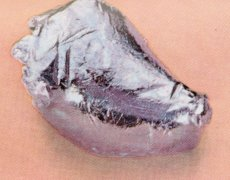
Technetium Forty-third Element of the Periodic Table
Technetium is a chemical element of symbol Tc of atomic number 43 (43 protons and 43 electrons) and atomic mass equal to 98 u. At room temperature, technetium is in a solid state. It is placed in group 7 (7B) of the periodic classification of the elements. It is a transitional metal, silver gray, radioactive, being obtained synthetically. Its main application is in nuclear medicine, in diagnostic techniques. It was discovered by Carlo Perrier and Emilio Segrée Lebrão in Italy in 1937.
Technetium is radioactive precisely because it is arranged by nuclear fusion with deuterium in particle accelerators made of molybdenum. When synthesized, it does not become stable and emits this proton from its nucleus, then decays again into molybdenum. It was the first element to be made artificially by man, hence its name derives from the Greek word "technetos", which means artificial.
Dmitri Mendeleyev predicted that the Periodic Table lacked an element that would be similar to manganese and called it eka-manganese. In 1925, when the rhenium was discovered, the atomic number 43 element was believed to have been found, and it was given the name masurium, but it was proved that it was not the predicted element. The development of nuclear energy in the mid-twentieth century allowed the first samples of this element to be generated through nuclear reactions.
Main Features: Technetium has all its radioactive isotopes, and therefore does not occur in nature and was the first element to be artificially produced. Its most common oxidation states are +2, +4, +5, +6 and +7.
It is a silver gray metal, which slowly loses its shine in contact with damp air. Technetium VII such as pertechnetate, TcO4-, like rhenium, ReO4-, is much less oxidizing than permanganate, MnO4-. The technetium chemistry is very similar to that of rhenium, although these two differ greatly from that of manganese. Technetium dissolves in regal water (mixture of HNO3 and HCl), nitric acid (HNO3) and concentrated sulfuric acid (H2SO4), but is not soluble in hydrochloric acid (HCl). This element inhibits steel corrosion well, and is an excellent superconductor at temperatures below 11K.
In nuclear medicine compounds with the 99mTc isotope are employed as radiopharmaceuticals (or radiotracers). This isotope is obtained by means of 99Mo / 99mTc generators, and its disintegration period is 6 hours, adequate time to accumulate in the organ to be studied and, on the other hand, not to stay long in the organism. It is a gamma emitter with an energy of approximately 140 KeV, which can be detected by a scintillation counter and the image obtained can be interpreted.
Several compounds are prepared by reducing pertechnectates together with other molecules, depending on the organ to be studied. For example, with bisphosphonates, these compounds accumulate in bone tissues. When pertechnates are used directly, they accumulate in the thyroid gland.
Abundance and Obtainment:
Until 1960 it was not possible to obtain this element in macroscopic quantities. The expansion of the nuclear industry has meanwhile made it possible to obtain large quantities of technetium (kilograms).
Some red giant stars have an emission line in their spectrum corresponding to the presence of technetium; This discovery has led to new theories about the production of heavy elements in stars.
Since its discovery, numerous searches have been carried out on terrestrial materials from natural sources. In 1982, 99Tc was isolated and identified in very small quantities in pechblenda mineral from Africa as a product of spontaneous fission of 99Mo. This discovery was made by B.T. Kenna and P.K. Kuroda.
99Tc is obtained as waste from nuclear reactors, separating it from other fission products. (By reacting Tc2S7 with H2 at 1100 ° C or NH4 TcO4 with H2).
Technetium is radioactive precisely because it is arranged by nuclear fusion with deuterium in particle accelerators made of molybdenum. When synthesized, it does not become stable and emits this proton from its nucleus, then decays again into molybdenum. It was the first element to be made artificially by man, hence its name derives from the Greek word "technetos", which means artificial.
History:
The name technetium comes from the Greek technetos, which means "artificial". It was discovered by Carlo Perrier and Emilio Segré in Italy in 1937 in a molybdenum sample sent by Ernest Lawrence, who was bombarded with deuterium nuclei on a Berkeley cyclotron. Technetium was the first element to be artificially produced.Dmitri Mendeleyev predicted that the Periodic Table lacked an element that would be similar to manganese and called it eka-manganese. In 1925, when the rhenium was discovered, the atomic number 43 element was believed to have been found, and it was given the name masurium, but it was proved that it was not the predicted element. The development of nuclear energy in the mid-twentieth century allowed the first samples of this element to be generated through nuclear reactions.
Main Features: Technetium has all its radioactive isotopes, and therefore does not occur in nature and was the first element to be artificially produced. Its most common oxidation states are +2, +4, +5, +6 and +7.
It is a silver gray metal, which slowly loses its shine in contact with damp air. Technetium VII such as pertechnetate, TcO4-, like rhenium, ReO4-, is much less oxidizing than permanganate, MnO4-. The technetium chemistry is very similar to that of rhenium, although these two differ greatly from that of manganese. Technetium dissolves in regal water (mixture of HNO3 and HCl), nitric acid (HNO3) and concentrated sulfuric acid (H2SO4), but is not soluble in hydrochloric acid (HCl). This element inhibits steel corrosion well, and is an excellent superconductor at temperatures below 11K.
Applications:
Technetium could have various applications, for example in steels protecting them from corrosion, but due to problems with their production (in nuclear reactors), these applications are very limited.In nuclear medicine compounds with the 99mTc isotope are employed as radiopharmaceuticals (or radiotracers). This isotope is obtained by means of 99Mo / 99mTc generators, and its disintegration period is 6 hours, adequate time to accumulate in the organ to be studied and, on the other hand, not to stay long in the organism. It is a gamma emitter with an energy of approximately 140 KeV, which can be detected by a scintillation counter and the image obtained can be interpreted.
Several compounds are prepared by reducing pertechnectates together with other molecules, depending on the organ to be studied. For example, with bisphosphonates, these compounds accumulate in bone tissues. When pertechnates are used directly, they accumulate in the thyroid gland.
Abundance and Obtainment:
Until 1960 it was not possible to obtain this element in macroscopic quantities. The expansion of the nuclear industry has meanwhile made it possible to obtain large quantities of technetium (kilograms).
Some red giant stars have an emission line in their spectrum corresponding to the presence of technetium; This discovery has led to new theories about the production of heavy elements in stars.
Since its discovery, numerous searches have been carried out on terrestrial materials from natural sources. In 1982, 99Tc was isolated and identified in very small quantities in pechblenda mineral from Africa as a product of spontaneous fission of 99Mo. This discovery was made by B.T. Kenna and P.K. Kuroda.
99Tc is obtained as waste from nuclear reactors, separating it from other fission products. (By reacting Tc2S7 with H2 at 1100 ° C or NH4 TcO4 with H2).