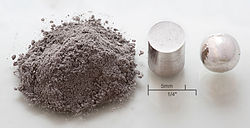
Rhodium Forty-fifth Element of the Periodic Table
Rhodium is a chemical element of symbol Rh of atomic number 45 (45 protons and 45 electrons) and atomic mass equal to 102,9 u. At room temperature, rhodium is in a solid state.
It is situated in group 9 (8 B) of the Periodic Classification of Elements. It is a transition metal, not abundant, of the platinum group. It is commonly found in platinum mines and is used as a catalyst and in high strength platinum alloys. It was discovered in 1803 by William Hyde Wollaston.
History:
Rhodium (from the Greek rhodon meaning "rose") was discovered in 1803 by William Hyde Wollaston shortly after the discovery of palladium. Wollaston verified the existence of the rhodium element in England in an unrefined platinum ore probably from South America.
Wollaston's procedure was to dissolve the ore in royal water, neutralizing the acid with sodium hydroxide (NaOH). Platinum precipitated by adding ammonium chloride, NH4Cl, as ammonium chloroplatinate. The palladium element was removed as palladium cyanide after treating the solution with mercury cyanide. The remaining material was a red substance with rhodium chloride, from which rhodium was isolated by reduction with hydrogen gas.
Main Features: Rhodium is a ductile metal of silver-white color and is a great light reflector. It is not attacked by acids, but dissolves in regia water or concentrated and heated sulfuric acid (H2SO4) when finally divided. Rhodium has a higher melting point than platinum and a lower density. Its most common oxidation states are +2, +3, 0 and -1.
Applications:
The main application of this element is as a binder to harden platinum and palladium. These alloys are used in furnace coils, fiberglass bushings, high temperature thermocouple components, aircraft spark plugs, and laboratory crucibles.
Other Uses:
As an electrical contact material (connectors) due to its low electrical resistance and high corrosion resistance. Metal rhodium plating coatings obtained by electroplating or evaporation due to high hardness and optical reflection are used for the production of optical instruments. This metal finds use for the production of jewelry and decorative objects. It is also used in numerous industrial processes as a catalyst, as an automotive catalyst (catalytic converter), and in the carbonylation of methanol for the formation of acetic acid.
Occurrence:
Industrial extraction of rhodium is complex because in ores it is found mixed with other metals such as palladium, silver, platinum and gold. It is found in platinum ores, and is obtained free as an inert and difficult-to-melt white metal. The main sources of this element are located in the sands of the Urals rivers in North and South America and also in the nickel copper - sulfide mines in the Sudbury region (Ontario). Although the amount in Sudbary is very small, the large amount of nickel extracted makes it profitable to obtain rhodium as a byproduct. Due to the small quantities of rhodium ores world production is only 7 to 8 tons per year.
It is also possible to extract rhodium from burnt nuclear fuel, which contains some percent of this metal. The obtained radioisotopes have half-life periods of up to 45 days. Therefore, the sale of material from this source should be careful only after verifying that no radioactive contamination has occurred.
It is situated in group 9 (8 B) of the Periodic Classification of Elements. It is a transition metal, not abundant, of the platinum group. It is commonly found in platinum mines and is used as a catalyst and in high strength platinum alloys. It was discovered in 1803 by William Hyde Wollaston.
History:
Rhodium (from the Greek rhodon meaning "rose") was discovered in 1803 by William Hyde Wollaston shortly after the discovery of palladium. Wollaston verified the existence of the rhodium element in England in an unrefined platinum ore probably from South America.
Wollaston's procedure was to dissolve the ore in royal water, neutralizing the acid with sodium hydroxide (NaOH). Platinum precipitated by adding ammonium chloride, NH4Cl, as ammonium chloroplatinate. The palladium element was removed as palladium cyanide after treating the solution with mercury cyanide. The remaining material was a red substance with rhodium chloride, from which rhodium was isolated by reduction with hydrogen gas.
Main Features: Rhodium is a ductile metal of silver-white color and is a great light reflector. It is not attacked by acids, but dissolves in regia water or concentrated and heated sulfuric acid (H2SO4) when finally divided. Rhodium has a higher melting point than platinum and a lower density. Its most common oxidation states are +2, +3, 0 and -1.
Applications:
The main application of this element is as a binder to harden platinum and palladium. These alloys are used in furnace coils, fiberglass bushings, high temperature thermocouple components, aircraft spark plugs, and laboratory crucibles.
Other Uses:
As an electrical contact material (connectors) due to its low electrical resistance and high corrosion resistance. Metal rhodium plating coatings obtained by electroplating or evaporation due to high hardness and optical reflection are used for the production of optical instruments. This metal finds use for the production of jewelry and decorative objects. It is also used in numerous industrial processes as a catalyst, as an automotive catalyst (catalytic converter), and in the carbonylation of methanol for the formation of acetic acid.
Occurrence:
Industrial extraction of rhodium is complex because in ores it is found mixed with other metals such as palladium, silver, platinum and gold. It is found in platinum ores, and is obtained free as an inert and difficult-to-melt white metal. The main sources of this element are located in the sands of the Urals rivers in North and South America and also in the nickel copper - sulfide mines in the Sudbury region (Ontario). Although the amount in Sudbary is very small, the large amount of nickel extracted makes it profitable to obtain rhodium as a byproduct. Due to the small quantities of rhodium ores world production is only 7 to 8 tons per year.
It is also possible to extract rhodium from burnt nuclear fuel, which contains some percent of this metal. The obtained radioisotopes have half-life periods of up to 45 days. Therefore, the sale of material from this source should be careful only after verifying that no radioactive contamination has occurred.