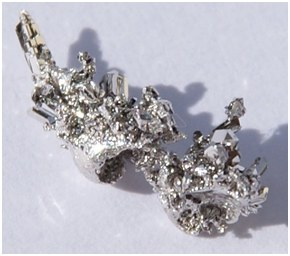
Palladium Forty-sixth Element of the Periodic Table
Key Features:
Palladium is a platinum-like silver white metal, does not oxidize with air, and is the element of the lowest density and lowest melting point platinum group. It is soft and ductile when heated, greatly increasing its hardness and toughness when cold worked. It can be dissolved in sulfuric acid, H2SO4, and nitric acid, HNO3. It may also be dissolved, even slowly, in hydrochloric acid (HCl) in the presence of chlorine or oxygen. This element can absorb large amounts of molecular hydrogen, H2, at room temperature (up to 900 times its volume), which is used to purify it. The process is believed to form Pd2H. The most common oxidation states of palladium are +2 and +4 and their atomic mass is 106.4.
History:
Its designation derives from the asteroid Pallas (Greek goddess that alludes to wisdom), which was discovered in the same period. The element was discovered in 1803 by English-born chemist William Hyde Wollaston.
Applications:
It is applicable in the electrical industry, in the manufacture of contacts in electromechanical systems, such as relays. In the chemical and pharmaceutical industry it is used as a catalyst for hydrogenation reactions and in the petroleum industry palladium is important in the catalysis of distilled petroleum fractions. The element also applies to some metal alloys used in dentistry or dentistry. In jewelry, palladium is hardened with a small fraction of ruthenium or rhodium, or it can be used as a gold bleacher, giving rise to the so-called "white gold".
Palladium is a platinum-like silver white metal, does not oxidize with air, and is the element of the lowest density and lowest melting point platinum group. It is soft and ductile when heated, greatly increasing its hardness and toughness when cold worked. It can be dissolved in sulfuric acid, H2SO4, and nitric acid, HNO3. It may also be dissolved, even slowly, in hydrochloric acid (HCl) in the presence of chlorine or oxygen. This element can absorb large amounts of molecular hydrogen, H2, at room temperature (up to 900 times its volume), which is used to purify it. The process is believed to form Pd2H. The most common oxidation states of palladium are +2 and +4 and their atomic mass is 106.4.
History:
Its designation derives from the asteroid Pallas (Greek goddess that alludes to wisdom), which was discovered in the same period. The element was discovered in 1803 by English-born chemist William Hyde Wollaston.
Applications:
It is applicable in the electrical industry, in the manufacture of contacts in electromechanical systems, such as relays. In the chemical and pharmaceutical industry it is used as a catalyst for hydrogenation reactions and in the petroleum industry palladium is important in the catalysis of distilled petroleum fractions. The element also applies to some metal alloys used in dentistry or dentistry. In jewelry, palladium is hardened with a small fraction of ruthenium or rhodium, or it can be used as a gold bleacher, giving rise to the so-called "white gold".