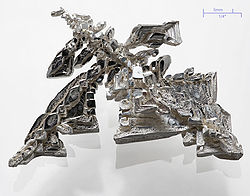
Silver Forty Seventh Element of the Periodic Table
Silver or argento1 (from Latin platta * 2, argentum) is a chemical element of Ag symbol and atomic number of 47 (47 protons and 47 electrons). At room temperature, the silver is in the solid state. In the flame test, it takes on the color lilac.
The origin of the word silver is from Indo-European, "arg", which means brilliant and would be the Sanskrit equivalent of ar-jun which also means brilliant.3 It is estimated to have been discovered shortly after copper and gold.4 5
Features: Most silver is a by-product of lead mining and is often associated with copper. Among the metals, it is the one that most conducts electric current, surpassing copper and gold.
Silver usually occurs in compact form such as nuggets or grains, although it can also be found in fibrous, dendritic (tree-shaped) aggregates. When recently mined or polished, it has a characteristic bright silver-white color and a metallic sheen. This metal is stable in fresh air and water, but is coated with an oxidizing film when exposed to ozone, sulfur gas or sulfur air. Because of this and the fact that it is too malleable to be used in jewelry in its pure form, silver is often bonded to other metals, or given a gold overlay.
Silver is toxic. However, most of their salts are not poisonous due to the characteristics of their anios. These compounds are absorbed into the body and remain in the blood until they deposit on mucous membranes, forming a grayish film. Silver poisoning is called argiria. There are, however, other silver compounds, such as nitrate, that have an antiseptic effect. Silver nitrate solutions are used in the treatment of mucous membrane irritations of the mouth and throat. Some silver-containing proteins are powerful anti-irritants for the membranes of the eyes, ear, nose and throat.
Occurrence:
The world's main silver mining areas are in South America, the United States, Australia, and the former Soviet Union. The largest single producer of silver is probably Mexico, where silver has been mined from around 1500 AD until today. The best natural silver, which occurs in the form of twisted wire, is that of Kongsberg, Norway.
The largest mines in the world are Cannington (Australia), Fresnillo (Mexico), San Cristobal (Bolivia), Antamina (Peru), Rudna (Poland) and Penasquito (Mexico) 6 Producing countries In the world, the American continent is the largest producer of silver. Ten countries produced around 84% of the world's silver in 2010.
The origin of the word silver is from Indo-European, "arg", which means brilliant and would be the Sanskrit equivalent of ar-jun which also means brilliant.3 It is estimated to have been discovered shortly after copper and gold.4 5
Features: Most silver is a by-product of lead mining and is often associated with copper. Among the metals, it is the one that most conducts electric current, surpassing copper and gold.
Silver usually occurs in compact form such as nuggets or grains, although it can also be found in fibrous, dendritic (tree-shaped) aggregates. When recently mined or polished, it has a characteristic bright silver-white color and a metallic sheen. This metal is stable in fresh air and water, but is coated with an oxidizing film when exposed to ozone, sulfur gas or sulfur air. Because of this and the fact that it is too malleable to be used in jewelry in its pure form, silver is often bonded to other metals, or given a gold overlay.
Silver is toxic. However, most of their salts are not poisonous due to the characteristics of their anios. These compounds are absorbed into the body and remain in the blood until they deposit on mucous membranes, forming a grayish film. Silver poisoning is called argiria. There are, however, other silver compounds, such as nitrate, that have an antiseptic effect. Silver nitrate solutions are used in the treatment of mucous membrane irritations of the mouth and throat. Some silver-containing proteins are powerful anti-irritants for the membranes of the eyes, ear, nose and throat.
Occurrence:
The world's main silver mining areas are in South America, the United States, Australia, and the former Soviet Union. The largest single producer of silver is probably Mexico, where silver has been mined from around 1500 AD until today. The best natural silver, which occurs in the form of twisted wire, is that of Kongsberg, Norway.
The largest mines in the world are Cannington (Australia), Fresnillo (Mexico), San Cristobal (Bolivia), Antamina (Peru), Rudna (Poland) and Penasquito (Mexico) 6 Producing countries In the world, the American continent is the largest producer of silver. Ten countries produced around 84% of the world's silver in 2010.