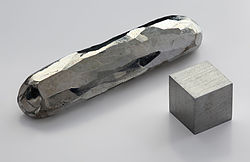
Cadmium Forty-eighth Element of the Periodic Table
Cadmium is a chemical element of Cd symbol of atomic number 48 (48 protons and 48 electrons) and of atomic mass equal to 112.4 u. At room temperature, cadmium is in the solid state.
It is located in group 12 (2 B) of the periodic classification of elements. It is a bluish white metal, relatively little abundant. It is one of the most toxic metals, despite being an essential chemical element, necessary in very small quantities, however, its biological function is not very clear. It is usually found in zinc mines and is mainly used in the manufacture of batteries.
History:
Cadmium (from Latin, cadmia, and Greek kadmeia, meaning "calamine", the name formerly called zinc carbonate) was discovered in Germany in 1817 by Friedrich Strohmeyer, noting that some samples of impaled calamine changed color. when heated, which was not the case with pure calamine. The new element, cadmium, has been found as impurity in this zinc compound. For about a hundred years Germany was the main producer of this metal.
In 1888, Van Gogh used cadmium compounds as the dye in part of Twelve Sunflowers in a Jar. At the 1927 International Conference on Weights and Measures, the meter was redefined along a cadmium spectral line. However, this definition was changed later.
Applications:
Approximately 75% of the cadmium produced is used in the manufacture of batteries, especially nickel cadmium batteries. 25% is used in electroplating (as a coating). Some salts are used as pigments. For example, cadmium sulfate is employed as yellow pigment. It is used in some low melting alloys (mainly Newton and Wood alloys). Due to its low coefficient of friction it is very resistant to fatigue and is used in pillow alloys. Many types of weld contain this metal. In control bars in nuclear fission. Some cadmium phosphorescent compounds are employed in televisions. It is employed in some semiconductors. Some cadmium compounds are used as plastic stabilizers such as PVC.
Abundance and obtaining:
Cadmium is a scarce element in the earth's crust. Reserves are hard to find and exist in small quantities. In minerals it is usually replaced by zinc due to chemical similarity. Cadmium is generally obtained as a byproduct of zinc. It is separated from zinc by precipitation with sulfates or by distillation. Generally zinc and cadmium are in the minerals in the form of sulfides which burned give rise to a mixture of oxides and sulphates, and cadmium is separated taking advantage of its greater ease of reduction.
The most important zinc mineral is (Zn, Fe) S sphererite, similar to the cadmium mineral called greenockite or grinoquite, CdS. Cadmium, besides being obtained from mining and metallurgy of zinc sulfide, is also obtained, in a smaller amount, from lead and copper. There are other secondary sources of cadmium, one of which is from recycled scrap iron and steel, from which approximately 10% of the cadmium consumed is obtained.
Cadmium is an element found naturally in the earth's crust. It is a soft metal with a shine very similar to silver, but hardly found in the elemental form. In general, this metal is found bound to other elements, such as oxygen, chlorine or sulfur, to form compounds. All of these compounds are stable, non-evaporating solids. Only cadmium oxide is found in the atmosphere in the form of small particles.
Much of the cadmium used for industrial purposes is obtained as a product of the casting of rocks containing zinc, copper or lead. Cadmium has many industrial applications, but is often used for the production of pigments, electric cells and plastics.
Small amounts of cadmium are found naturally in air, water, soil and food. For most people, food is the main source of cadmium exposure because many foods tend to absorb and retain it. Plants absorb this element mainly from soil and water.
It is located in group 12 (2 B) of the periodic classification of elements. It is a bluish white metal, relatively little abundant. It is one of the most toxic metals, despite being an essential chemical element, necessary in very small quantities, however, its biological function is not very clear. It is usually found in zinc mines and is mainly used in the manufacture of batteries.
History:
Cadmium (from Latin, cadmia, and Greek kadmeia, meaning "calamine", the name formerly called zinc carbonate) was discovered in Germany in 1817 by Friedrich Strohmeyer, noting that some samples of impaled calamine changed color. when heated, which was not the case with pure calamine. The new element, cadmium, has been found as impurity in this zinc compound. For about a hundred years Germany was the main producer of this metal.
In 1888, Van Gogh used cadmium compounds as the dye in part of Twelve Sunflowers in a Jar. At the 1927 International Conference on Weights and Measures, the meter was redefined along a cadmium spectral line. However, this definition was changed later.
Applications:
Approximately 75% of the cadmium produced is used in the manufacture of batteries, especially nickel cadmium batteries. 25% is used in electroplating (as a coating). Some salts are used as pigments. For example, cadmium sulfate is employed as yellow pigment. It is used in some low melting alloys (mainly Newton and Wood alloys). Due to its low coefficient of friction it is very resistant to fatigue and is used in pillow alloys. Many types of weld contain this metal. In control bars in nuclear fission. Some cadmium phosphorescent compounds are employed in televisions. It is employed in some semiconductors. Some cadmium compounds are used as plastic stabilizers such as PVC.
Abundance and obtaining:
Cadmium is a scarce element in the earth's crust. Reserves are hard to find and exist in small quantities. In minerals it is usually replaced by zinc due to chemical similarity. Cadmium is generally obtained as a byproduct of zinc. It is separated from zinc by precipitation with sulfates or by distillation. Generally zinc and cadmium are in the minerals in the form of sulfides which burned give rise to a mixture of oxides and sulphates, and cadmium is separated taking advantage of its greater ease of reduction.
The most important zinc mineral is (Zn, Fe) S sphererite, similar to the cadmium mineral called greenockite or grinoquite, CdS. Cadmium, besides being obtained from mining and metallurgy of zinc sulfide, is also obtained, in a smaller amount, from lead and copper. There are other secondary sources of cadmium, one of which is from recycled scrap iron and steel, from which approximately 10% of the cadmium consumed is obtained.
Cadmium is an element found naturally in the earth's crust. It is a soft metal with a shine very similar to silver, but hardly found in the elemental form. In general, this metal is found bound to other elements, such as oxygen, chlorine or sulfur, to form compounds. All of these compounds are stable, non-evaporating solids. Only cadmium oxide is found in the atmosphere in the form of small particles.
Much of the cadmium used for industrial purposes is obtained as a product of the casting of rocks containing zinc, copper or lead. Cadmium has many industrial applications, but is often used for the production of pigments, electric cells and plastics.
Small amounts of cadmium are found naturally in air, water, soil and food. For most people, food is the main source of cadmium exposure because many foods tend to absorb and retain it. Plants absorb this element mainly from soil and water.