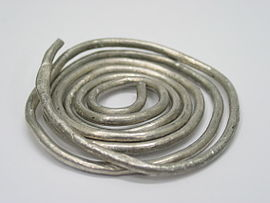
Indium Forty-ninth Element of the Periodic Table
Indium (from Latin indicum, indigo or indigo) is a chemical element of the At symbol 49 (49 protons and 49 electrons) and of atomic mass equal to 114.8 u. At room temperature, Indium is in a solid state.
It is a group 13 (IIIA) metal from the periodic classification of elements. It is not abundant, malleable, easily fusible, chemically similar to aluminum and gallium, but more similar to zinc. The main source of indium is from zinc mines. Used in the manufacture of liquid crystal mesh and in forming thin films that serve as lubricants. It was discovered by Ferdinand Reich and Theodor Richter in 1863 when they were looking for thallium in zinc mines.
History:
The Indian (name from the Indium color line of his atomic specter) was discovered by Ferdinand Reich and Theodor Richter in 1863 when they were looking for thallium in zinc mines using a spectrograph. It was isolated by Ritcher in 1867.
Key Features:
The Indium is a shiny silver white metal. When the metal is bent, it makes a distinctive sound. Its most characteristic oxidation state is +3, although it has a +1 state in some compounds.
Applications:
It was employed during World War II as a liner in high performance aircraft engines. After the war it was destined for new applications: in metal alloys, welding and in the electronics industry.
In the 1980s, he became interested in the use of semiconductor indium phosphates and thin indium tin oxide films for the development of liquid crystal displays (LCD).
Other applications:
In the manufacture of low melting point alloys. A 24% indium alloy with 76% gallium is liquid at room temperature. To produce photoconductors, germanium transistors and rectifiers. Mirror formation, as good as silver, but more resistant to corrosion. Its oxide is used in the manufacture of light panels. The radioactive isotope In-111 is used in nuclear medicine.
Abundance and obtaining:
Indium is used in the production of liquid crystal screens.
It is mainly produced from waste generated in the processing of zinc ores. It is also found in iron, lead and copper mines. It is obtained by electrolysis of its salts.
The amount of indium consumed is closely related to the worldwide production of liquid crystal displays (LCD). Increased production and recycling efficiency (especially in Japan) maintains a balance between demand and supply.
Until 1924 there was only one gram of the isolated element in the world. The earth's crust is estimated to have approximately 0.1 ppm indium (as abundant as silver). The main Indian producer is Canada.
It is a group 13 (IIIA) metal from the periodic classification of elements. It is not abundant, malleable, easily fusible, chemically similar to aluminum and gallium, but more similar to zinc. The main source of indium is from zinc mines. Used in the manufacture of liquid crystal mesh and in forming thin films that serve as lubricants. It was discovered by Ferdinand Reich and Theodor Richter in 1863 when they were looking for thallium in zinc mines.
History:
The Indian (name from the Indium color line of his atomic specter) was discovered by Ferdinand Reich and Theodor Richter in 1863 when they were looking for thallium in zinc mines using a spectrograph. It was isolated by Ritcher in 1867.
Key Features:
The Indium is a shiny silver white metal. When the metal is bent, it makes a distinctive sound. Its most characteristic oxidation state is +3, although it has a +1 state in some compounds.
Applications:
It was employed during World War II as a liner in high performance aircraft engines. After the war it was destined for new applications: in metal alloys, welding and in the electronics industry.
In the 1980s, he became interested in the use of semiconductor indium phosphates and thin indium tin oxide films for the development of liquid crystal displays (LCD).
Other applications:
In the manufacture of low melting point alloys. A 24% indium alloy with 76% gallium is liquid at room temperature. To produce photoconductors, germanium transistors and rectifiers. Mirror formation, as good as silver, but more resistant to corrosion. Its oxide is used in the manufacture of light panels. The radioactive isotope In-111 is used in nuclear medicine.
Abundance and obtaining:
Indium is used in the production of liquid crystal screens.
It is mainly produced from waste generated in the processing of zinc ores. It is also found in iron, lead and copper mines. It is obtained by electrolysis of its salts.
The amount of indium consumed is closely related to the worldwide production of liquid crystal displays (LCD). Increased production and recycling efficiency (especially in Japan) maintains a balance between demand and supply.
Until 1924 there was only one gram of the isolated element in the world. The earth's crust is estimated to have approximately 0.1 ppm indium (as abundant as silver). The main Indian producer is Canada.