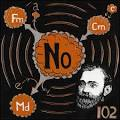
Nobelium One Hundred second element of the Periodic Table
Nobelium (named after Alfred Nobel) is a chemical element of the Periodic Table, symbol No, atomic number 102 (102 protons and 102 electrons), of atomic mass 259 u.
It is metalic, radioactive, transuranic, of the actinide group. It is synthesized by bombarding curium with carbon ions. It was first identified by a team led by Albert Ghiorso and Glenn T. Seaborg in 1958.
History:
Nobelium was first synthesized by Albert Ghiorso, Glenn T. Seaborg, John R. Walton and Torbørn Sikkeland in April 1958 at the University of California, Berkeley. The team used a new heavy ion linear accelerator (HILAC) by bombarding a curium target (95% Cm-244 and 4.5% Cm-246) with carbon-12 ions producing nobelium-254 (55 second half-life) . This discovery was confirmed by the Soviets in Dubna.
However, a year earlier, physicists at the Nobel Institute in Sweden announced that they synthesized an element 102 isotope. The team reported that they created a 10-minute half-life isotope at 8.5 MeV after bombarding curium-244 with carbon-13 nuclei. . Based on this report, the IUPAC Atomic Mass Commission has accepted the name "nobelium" and the symbol "No" for the "new" element. Later the Russians and Americans tried to repeat the experience of Swedish physicists and failed.
In 1966 researchers at UC Berkeley confirmed the 1958 experiments demonstrating the achievement of nobelium-254 (half-life of 55 seconds), nobelium-252 (half-life of 2.3 seconds) and nobelium-257 (half-life of 23 seconds). ). The following year Ghiorso's team decided to keep the name "Nobel" and the symbol "No" for element 102.
Nobelium was the most recent element discovered when Tom Lehrer wrote The Song of the Elements. Consequently, it was the element with the largest atomic number included.
Compounds:
It has not yet been possible to isolate and characterize compounds of the element. However, it has been found that this element often forms the No + 2 ion, unlike the other americium actinides onwards, which form ions with nox +3. Accordingly, nobelium is expected to form divalent compounds with properties similar to radio compounds.
Isotopes:
13 nobelium radioisotopes were identified, the most stable being No-259 with a half-life of 58 minutes, No-255 with a half-life of 3.1 minutes, and No-253 with a half-life of 1.7 minutes. All other radioactive isotopes have half-lives of less than 56 seconds, and most of them below 2.4 seconds. This element also has 1 meta state, No-254m t½ 0.28 seconds).
The atomic masses of known nobelium isotopes range from 249,088 u (No-249) to 262,108 u (No-262). The first decay mode before the most stable isotope, No-259, is alpha emission, and the first mode after is spontaneous fission. The primary decay product before No-259 is the fermium isotope, and the after products are energy and subatomic particles.
Main Features: Little is known about nobelium, and only small quantities of this element have been produced so far. Outside the search scope no use was found for this element. The most stable isotope, nobelium-259, has a half-life of 58 minutes, and decays to fermium-255 by alpha emission or to mendelevium-259 by electron capture.
It is metalic, radioactive, transuranic, of the actinide group. It is synthesized by bombarding curium with carbon ions. It was first identified by a team led by Albert Ghiorso and Glenn T. Seaborg in 1958.
History:
Nobelium was first synthesized by Albert Ghiorso, Glenn T. Seaborg, John R. Walton and Torbørn Sikkeland in April 1958 at the University of California, Berkeley. The team used a new heavy ion linear accelerator (HILAC) by bombarding a curium target (95% Cm-244 and 4.5% Cm-246) with carbon-12 ions producing nobelium-254 (55 second half-life) . This discovery was confirmed by the Soviets in Dubna.
However, a year earlier, physicists at the Nobel Institute in Sweden announced that they synthesized an element 102 isotope. The team reported that they created a 10-minute half-life isotope at 8.5 MeV after bombarding curium-244 with carbon-13 nuclei. . Based on this report, the IUPAC Atomic Mass Commission has accepted the name "nobelium" and the symbol "No" for the "new" element. Later the Russians and Americans tried to repeat the experience of Swedish physicists and failed.
In 1966 researchers at UC Berkeley confirmed the 1958 experiments demonstrating the achievement of nobelium-254 (half-life of 55 seconds), nobelium-252 (half-life of 2.3 seconds) and nobelium-257 (half-life of 23 seconds). ). The following year Ghiorso's team decided to keep the name "Nobel" and the symbol "No" for element 102.
Nobelium was the most recent element discovered when Tom Lehrer wrote The Song of the Elements. Consequently, it was the element with the largest atomic number included.
Compounds:
It has not yet been possible to isolate and characterize compounds of the element. However, it has been found that this element often forms the No + 2 ion, unlike the other americium actinides onwards, which form ions with nox +3. Accordingly, nobelium is expected to form divalent compounds with properties similar to radio compounds.
Isotopes:
13 nobelium radioisotopes were identified, the most stable being No-259 with a half-life of 58 minutes, No-255 with a half-life of 3.1 minutes, and No-253 with a half-life of 1.7 minutes. All other radioactive isotopes have half-lives of less than 56 seconds, and most of them below 2.4 seconds. This element also has 1 meta state, No-254m t½ 0.28 seconds).
The atomic masses of known nobelium isotopes range from 249,088 u (No-249) to 262,108 u (No-262). The first decay mode before the most stable isotope, No-259, is alpha emission, and the first mode after is spontaneous fission. The primary decay product before No-259 is the fermium isotope, and the after products are energy and subatomic particles.
Main Features: Little is known about nobelium, and only small quantities of this element have been produced so far. Outside the search scope no use was found for this element. The most stable isotope, nobelium-259, has a half-life of 58 minutes, and decays to fermium-255 by alpha emission or to mendelevium-259 by electron capture.