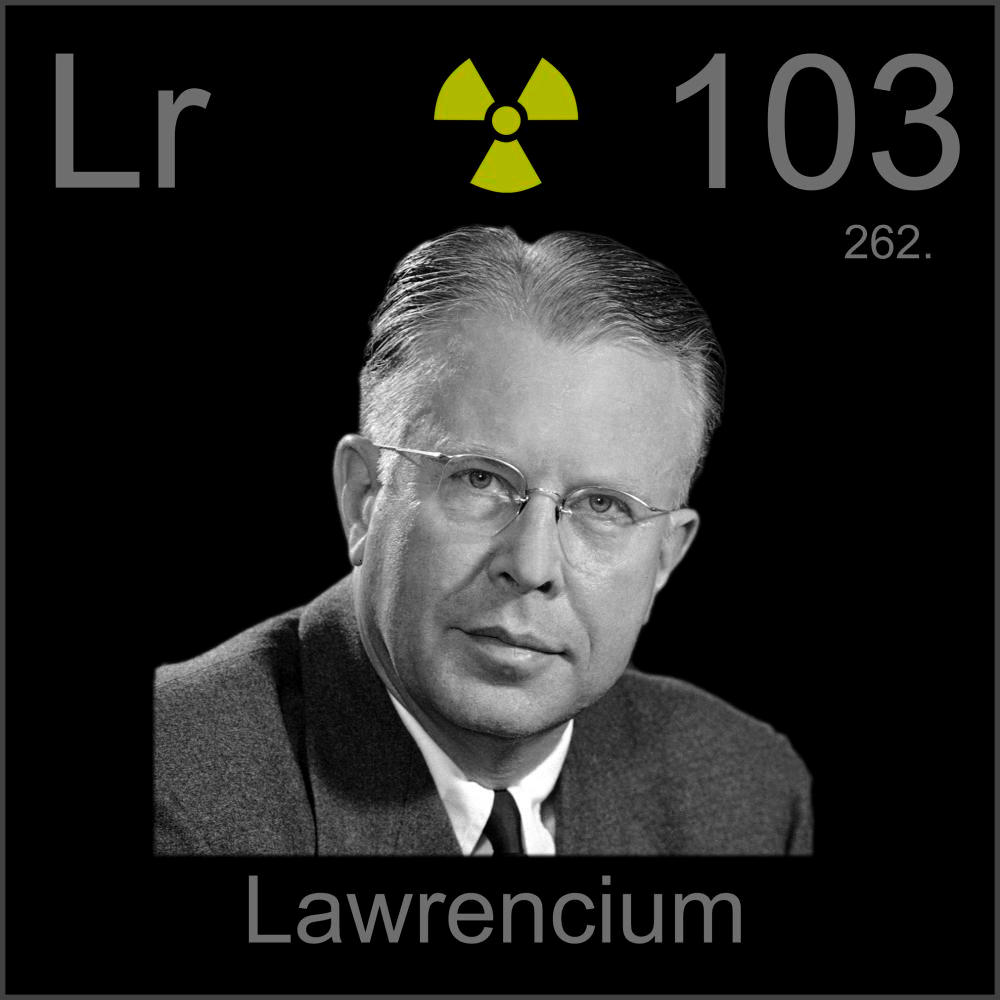
Laurencium One Hundred Third Periodic Table element
The laurencium1 or laurencium2 (name given in honor of Ernest O. Lawrence) is a synthetic chemical element, symbol Lr, atomic number 103 (103 protons and 103 electrons) and with atomic mass [262] u. It is a radioactive element, of short duration, transuranic, last element of the group of the actinides although it is in block d.
This element was synthesized from Boron ions' californium in 1961 at the Berkeley Laboratory, California, United States, by a team of scientists led by Albert Ghiorso.
Main features:
The appearance of this element is unknown, however, it is very likely to be metallic, solid, silvery white or gray. If sufficient amounts of lawrencium are produced they will present the danger of radiation. Little is known about the chemical properties of this element, but preliminary work with a few atoms indicated that it is similar to actinides.
Laurencium was and, still often, is grouped in the actinídeos chemical series in the periodic table. However, unlike the other rare earths, element 103 is an element of block d, consequently, it is being placed more and more in the set of other elements of 'block D', that is, in the chemical series of transition metals.
History:
Laurencium was discovered on February 14, 1961 by a group of scientists from the "Lawrence Berkeley National Laboratory" (then "Berkeley Radiation Laboratory") of the University of California at Berkeley. Among those involved in the project were: Albert Ghiorso, Torbjorn Sikkeland, Almon E. Larsh and Robert M. Latimer. The lawrêncio was produced in a "Linear Accelerator of Heavy Ions" (HILAC), bombarding 3 milligrams of californium (3 different isotopes) with boron ions (isotopes 10B and 11B. The results were obtained by the Berkeley team with the mass ion 257 and the atomic number 103. It was then discovery of the "element 103", for which the name Lawrêncio was suggested, in honor of Ernest O. Lawrence.
In 1967, researchers in Dubna, Russia, reported that they could not confirm an emitter of an alpha particle, with a period of 2.4 seconds, as that of Z = 103, M = 257. However, it was attributed to 258Lr or 259Lr isotopes. Eleven isotopes of element 103 were synthesized, with 262Lr being the longest half-life: 216 minutes (decaying 256Nb). The isotopes of lawrencium decay via alpha emission (most common type), spontaneous fission and electron capture (less common).
The name of the element (laurencium), preferred by the "American Society of Chemistry", comes from a tribute to the scientist Ernest O. Lawrence, inventor of the cyclotron. The symbol "Lw" was assigned to the element in 1963, but was changed to "Lr" in August 1977 by IUPAC at a meeting in Geneva.
This element was synthesized from Boron ions' californium in 1961 at the Berkeley Laboratory, California, United States, by a team of scientists led by Albert Ghiorso.
Main features:
The appearance of this element is unknown, however, it is very likely to be metallic, solid, silvery white or gray. If sufficient amounts of lawrencium are produced they will present the danger of radiation. Little is known about the chemical properties of this element, but preliminary work with a few atoms indicated that it is similar to actinides.
Laurencium was and, still often, is grouped in the actinídeos chemical series in the periodic table. However, unlike the other rare earths, element 103 is an element of block d, consequently, it is being placed more and more in the set of other elements of 'block D', that is, in the chemical series of transition metals.
History:
Laurencium was discovered on February 14, 1961 by a group of scientists from the "Lawrence Berkeley National Laboratory" (then "Berkeley Radiation Laboratory") of the University of California at Berkeley. Among those involved in the project were: Albert Ghiorso, Torbjorn Sikkeland, Almon E. Larsh and Robert M. Latimer. The lawrêncio was produced in a "Linear Accelerator of Heavy Ions" (HILAC), bombarding 3 milligrams of californium (3 different isotopes) with boron ions (isotopes 10B and 11B. The results were obtained by the Berkeley team with the mass ion 257 and the atomic number 103. It was then discovery of the "element 103", for which the name Lawrêncio was suggested, in honor of Ernest O. Lawrence.
In 1967, researchers in Dubna, Russia, reported that they could not confirm an emitter of an alpha particle, with a period of 2.4 seconds, as that of Z = 103, M = 257. However, it was attributed to 258Lr or 259Lr isotopes. Eleven isotopes of element 103 were synthesized, with 262Lr being the longest half-life: 216 minutes (decaying 256Nb). The isotopes of lawrencium decay via alpha emission (most common type), spontaneous fission and electron capture (less common).
The name of the element (laurencium), preferred by the "American Society of Chemistry", comes from a tribute to the scientist Ernest O. Lawrence, inventor of the cyclotron. The symbol "Lw" was assigned to the element in 1963, but was changed to "Lr" in August 1977 by IUPAC at a meeting in Geneva.