Neon tenth element of the Periodic Table
It is known by the name of Neon or Neon, a chemical element classified as noble gas. A member of the 8A family, its symbol is Ne, and the atomic number is 10 (10 protons and 10 electrons) and has the atomic weight 20.183u. It is considered the second lightest noble gas, and its name comes from the Greek term neos, meaning "new." Natural neon is a mixture of three stable isotopes: Neon-20 (90.02%), Ne-21 (0.26%) and Ne-22 (8.82%) and exists in a very small amount in the atmosphere ( 18.18 ppm / volume). Regarding its characteristics, the neon appears as a colorless, odorless, inert, non-flammable and non-toxic monoatomic gas, present in small quantities in atmospheric air, and in dry air it represents only 0.0015% of volume, and within the rocks of the earth's crust. The difference between their melting and boiling points is just over 2.5 ° C (-248.67 ° C and -246.048 ° C, respectively). The neon is present in the atmosphere in the ratio of approximately 1 part to 65000 parts of air. In order to isolate it, liquefied air must be subjected to fractional distillation, and it is doubtful whether any unstable fluorine compounds can form.In 1898 Sir William Ramsay and Morris W. Travers discovered a new element in the first fraction of liquid argon distillation as a volatile fraction component of liquefied raw argon. This new element was given the name of neon.
F.W. Aston later demonstrated that the neon was a mixture of two isotopes 20Ne and 22Ne. With this experience, he was the first to apply the concept of isotope to non-radioactive elements.
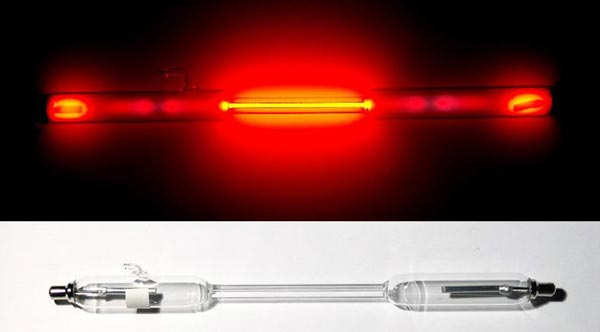
Neon gas became widely known after the discovery of a peculiar property, that of emitting bright light of different shades when it is crossed by an electric current under low pressures. Such property was soon employed in the well-known neon signs and some fluorescent lamps. In large cities, luminous billboards used for commercials are common, and are widely traded as compressed gas in steel cylinders and also in one liter glass vials at atmospheric pressure.
Other uses of gas include lamp filling, electronic tubes, plasma studies, X-ray valves (mixed with argon), cryogenic refrigeration, flame throwers, Geiger-Mueller tubes, filling in some metal vapor lasers, helium and neon lasers, laboratory ion detector gas, and cryogenic liquid for ultra-sensitive infrared sensors.
Bibliography:
FROM SOUZA, Lily Alves. Neon gas. Available at: