Fluor ninth Element of the Periodic Table
Fluoride, a chemical element represented by the symbol F, is located in the Periodic Table in the family 17A, atomic mass 19 and atomic number 9. It stands out in the Table for being the most electronegative and reactive element of all elements, a halogen that in temperature. The environment is in the form of a highly irritating yellow gas (F2).
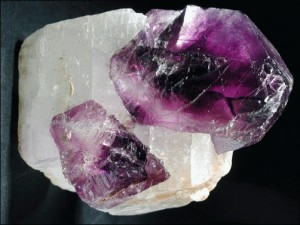
Fluorite (CaF2) - Bom Jesus da Lapa / BA / Brazil (CMULBRA 00217) (picture above)
It is classified as ametal forming compounds with virtually all other elements. There are cases of reacting explosively in atomic interactions. As already mentioned, fluorine has affinity for many elements (it is very reactive), so it cannot be stored in glass containers because the glass contains the silicon element which is highly reactive with fluorine.
The name given by Andre Ampere originates from the Latin fluere (“running”), but in 1529 was described by Georgius Agricola in the use of melting point reduction of the metal in fluorite (CaF2) form. Ampere after baptizing fluorine resolved it from the other nomenclature (phothoros), but the name fluorine was already being used by chemists like Humphry Davy who also tried to isolate the element, so the first name remained.
Lavoisier in 1789 included in his table of simple substances (found in his "Traité Élémentaire de Chimie, present in an order nouveau et d'aprés les découvertes modernes") a fluoric radical as unknown.
In 1886 Henri Moissan succeeded in isolating the fluor element, a scientific fact that led him to receive in 1906 the Nobel Prize in Chemistry.
It is the 13th most abundant element on the planet, being among the halogens the most present in the earth's crust. It is found in minerals such as fluorite, cryolite and fluorapatite, fluorine is generally available to humans in the form of fluorides, a substance that is found in a variety of environments (in air, water, plants and animals). ). This element that in optimal doses helps in the physiological system, but in excessive amounts can cause diseases such as fluorosis. F2 is a toxic and corrosive gas that causes severe burns to the eyes, skin and respiratory system.
Read too: Fluoride Poisoning
Sources: http://www.ulbra.br/mineralogia/ http://www.e-school.com/ http://www.qmc.ufsc.br/qmcweb/articles http://en.wikipedia.org/wiki/Flower http://www.webelements.com/fluorine/
Fluorite (CaF2) - Bom Jesus da Lapa / BA / Brazil (CMULBRA 00217) (picture above)
It is classified as ametal forming compounds with virtually all other elements. There are cases of reacting explosively in atomic interactions. As already mentioned, fluorine has affinity for many elements (it is very reactive), so it cannot be stored in glass containers because the glass contains the silicon element which is highly reactive with fluorine.
The name given by Andre Ampere originates from the Latin fluere (“running”), but in 1529 was described by Georgius Agricola in the use of melting point reduction of the metal in fluorite (CaF2) form. Ampere after baptizing fluorine resolved it from the other nomenclature (phothoros), but the name fluorine was already being used by chemists like Humphry Davy who also tried to isolate the element, so the first name remained.
Lavoisier in 1789 included in his table of simple substances (found in his "Traité Élémentaire de Chimie, present in an order nouveau et d'aprés les découvertes modernes") a fluoric radical as unknown.
In 1886 Henri Moissan succeeded in isolating the fluor element, a scientific fact that led him to receive in 1906 the Nobel Prize in Chemistry.
It is the 13th most abundant element on the planet, being among the halogens the most present in the earth's crust. It is found in minerals such as fluorite, cryolite and fluorapatite, fluorine is generally available to humans in the form of fluorides, a substance that is found in a variety of environments (in air, water, plants and animals). ). This element that in optimal doses helps in the physiological system, but in excessive amounts can cause diseases such as fluorosis. F2 is a toxic and corrosive gas that causes severe burns to the eyes, skin and respiratory system.
Read too: Fluoride Poisoning
Sources: http://www.ulbra.br/mineralogia/ http://www.e-school.com/ http://www.qmc.ufsc.br/qmcweb/articles http://en.wikipedia.org/wiki/Flower http://www.webelements.com/fluorine/