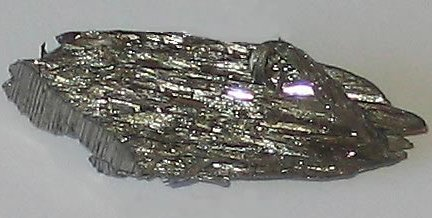
Lithium Third Periodic Table element
It is used in the manufacture of lithium metal or Lithium-ion batteries, is an alkaline metal of high oxidative potential (in fact, it is the easiest metal to suffer corrosion) belonging to the 1A family. In the ambient conditions it is solid and soft, it has a silvery white-silver coloration. Its chemical symbol is Li.It is the lightest known metal with a density equal to 0.534g / cm³, or almost half of the specific gravity of water. Its weighted atomic mass is worth approximately 7 u and its atomic number is equal to 3 (electrons and protons). The most common oxidation state is Li +.
Because it has the highest specific heat among solid substances, it is thus widely used in heat transfer. It is quite unstable (as alkaline metals generally do not exist in nature), and it reacts violently with water, releasing gaseous hydrogen and forming lithium hydroxide (LiOH, a strong base).
In addition to having high chemical affinity with water (hygroscopic), it tends to form oxides easily. Occurrence and Abundance:
Lepidolite:
Lithium is a rare metal in the earth's crust (its composition does not exceed 5ppm), though it is not commercially expensive. The largest sources of lithium available for extraction are lepidolite, petalite and spodumene. It is also found in several natural salts and sea water. Almost always obtained by the electrolysis of lithium chloride (LiCl).
Among the producing countries, Bolivia stands out: holding almost half of the world's reserves, whose goal is to produce almost 30 thousand tons per year by 2012. Accordingly, 25-30% of world production (estimated at 100 thousand tons metric tons per year).
Applications:
Batteries (in metallic or ionic form); Medications for psychic treatments (bipolarity, depression) in the form of lithium carbonate ?? Li 2 CO 3;ß Heat conducting metal alloys; Lubricant (lithium stereate); Air purifier in submarines and spaceships (acts by removing the carbon dioxide) Analgesic; Optical prisms (lithium fluoride).
Sources: THEODORE L. Brown,
H. EUGENE LeMay,
BRUCE E. Bursten.