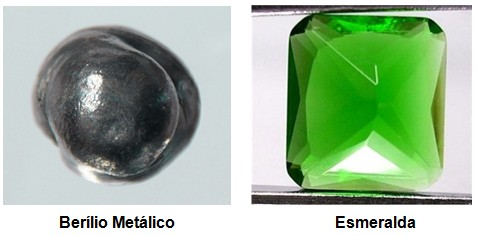
Beryllium fourth element of the Periodic Table
Beryllium alkaline earth metal is a chemical element belonging to the 2A family of the periodic table and symbol Be, has an atomic mass of 9.01218 gmol-1, atomic number 4, and its electronic configuration 1s2, 2s2, grayish white coloration, is hard, brittle and light but its melting and boiling point is high PE = 1278 ° C and PE = 3000 ° C.Discovered by Vauquelin in 1798, after his research with beryl and emerald ore, where he found the presence of an element, which was only isolated in 1828 by Wöhler and Bussy, independently by a reaction in alkaline and heated medium. > Beryllium is named after the ore which has been isolated, but Vauquelin, observing the metal, named it glucin because its compounds had a sweet taste because of its acidic character, but beryllium was the most common name. appropriate. Although sweet, the compounds of this element are extremely toxic and poisonous and can cause disease over the years or lead to death.
Chemically, beryllium is moderately reactive, does not react with water in the CNTP, and needs to be heated, even though beryllium is divalent, very similar to aluminum and alkaline earth metals in their properties. It is used in alloys with radio as a neutron emitter, and as a component in the manufacture of bronze, in the manufacture of weapons and rockets, and used in nuclear reactors for their ability to adsorb and reflect neutrons at the moment of uranium nuclear fission.
Chadwik discovered the neutrons in 1932 through the Ra-Be league, prompting Fermi to create the first known nuclear reactor. Beryllium is present in aquamarines, emeralds and obviously in beryl, are ores of high commercial price considered as jewelry, the emerald is more important and better known, its green color is presented by having 2% chromium in its composition. The molecular formula of emerald and beryl is the same, Be3Al2 (SiO3) 6 (Beryllium aluminum silicate). The metal is toxic due to the displacement of enzymatic magnesium.
Bibliography:
Vogel, Arthur Israel, 1905-Qualitative Analytical Chemistry / Arthur I. Vogel; [translation by Antonio Gimeno] 5. ed. rev. by G. Svehla.- São Paulo: Mestre Jou, 1981. Mahan, B. M. Chemistry: a university course. 4th ed. Sao Paulo: Edgard Blücher, 2003. SHRIVER, DUWARD; ATKINS, PETER. Inorganic Chemistry - 4th edition. Porto Alegre, Bookman, 2008. LEE, J.D .. Not so concise inorganic chemistry - translation of the 4th English edition. São Paulo, Edgard Blücher, 1996.