Boron Fifth Element of the Periodic Table
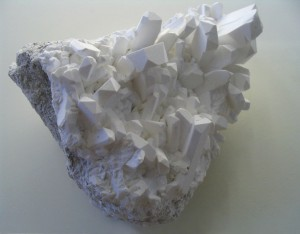
Boron is a very light chemical element of atomic mass 11u and atomic number 5. Its chemical symbol B is also the initial of the main ore containing it: Borax, since Boron is not found isolated in the earth's crust. It is considered a non-metal by the new periodic tables and is therefore a very bad conductor of electricity.Borax Crystals:
It is extremely hard (9.3 on the Mohs scale where the maximum score 10 belongs to the diamond) and reasonably electropositive, ie it tends to be oxidized and form acids such as ortho-boric acid (H3BO3). It has a dull dark brown color and is solid at room temperature. It does not conduct heat efficiently in its isolated form, but in the form of boron nitride (BN) it does as much as a metal. Present as the only natural isotope, Boron 10, the other radioisotopes have half-lives ranging from 0.77s (Boron 8) to 1 billion times shorter than that (Boron 9).
Pure boron is non-toxic, but if ingested in amounts greater than 50 mg causes indisposition. Its hydrogenated compounds are much more harmful as well as highly flammable. Occurrence
Because it is very reactive, Boron is not found free, but in ores such as: Colemanite (Ca2B6O11. 5H2O), Ulexite (CaNaB5O9. 8H2O) and Kernite or Borax (Na2B4O7.4H2O and Na2B4O7.10H2O, respectively) - are the world's leading sources of boron. Most of these ores are found in sedimentary marine rocks and near volcanoes. Boron is also found in vegetables (dark green leaves), fruits (dried, almonds, grapes, apples and pears) and vegetables (beans): meat of any kind does not provide significant amounts of boron or other compound that contain it. Its concentration in the earth's crust is approximately 10 ppm, ie, every 100 tons of rocks is 1 kilogram of boron. Reservations
The largest source of boron in the world is in California in the Mojave desert (in kernite form), but other countries are major producers of the mineral, especially Italy, Turkey, Bolivia, Chile and Peru. applications Elemental boron is not widely used, but studies show that if consumed in small quantities (10 to 15 mg) it helps fight osteoporosis by keeping calcium in the bones in the form of borates. In addition, it is used in green-colored fireworks and rocket launching.
Borax is widely used in animal taxidermy, insecticides, enamel and porcelain manufacturing, optical glass production, soap and detergent as a fertilizer, and is a major raw material in the manufacture of branded glass containers. registered Pyrex. Discovery Although the use of boron compounds has existed for over 6000 years, the first chemist to characterize and identify it as an element was the Swedish Jöns Jacob Berzelius in 1824. Other scientists, such as Gay-Lussac and Humphry Davy, achieved 50% purity Boron in 1808, however, did not characterize it as a new element. Pure compound was obtained in 1909 in the USA by chemist W. Weintraub.
Also read: Boron Compounds Sources: http://www.drashirleydecampos.com.br/ http://tabela.oxigenio.com/nao_metais/ http://nautilus.fis.uc.pt/st2.5/ http://www.mspc.eng.br/quim1/ http://www.if.ufrj.br/teaching/ http://www.infopedia.pt/$borax http://en.wikipedia.org/wiki/Boro.