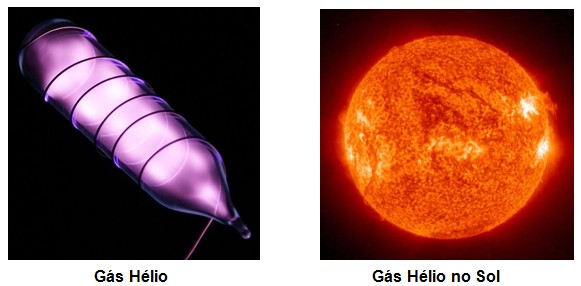
Helium Second Periodic Table element
The helium element is a noble gas, belonging to family 0 or 8A of the periodic table, is inert, that is, does not undergo chemical reaction, follows the rule of the duet (it is stable with 2 electrons in its last valence layer), has 8 isotopes, but practically despicable, because about 99.999% of the helium is the stable isotope 4He.It is colorless and odorless has atomic number 2 and electron configuration 1s2, atomic mass 4,002 u, its chemical symbol is He, its melting point is of -272.2 ° C and boiling point -268.9 ° C, even near absolute zero the gas does not solidify, it only forms unstable diatomic molecules.
Its name is Greek and means sun, where it was first observed in 1868 by scientist Pierre Jansen, during the solar eclipse, through detection of a yellow light in the solar spectrum, Norman Lockyer and Edward Frankland, confirming the observation of the scientist named the element with this name. Being first isolated on our planet in the year 1895 by Willian Ramsay, through the treatment of uranium ore called clevita, with mineral acids, because until now it was believed that helium was present only in the sun.
Non-toxic, it is used in a mixture of air for rocket pressurization, air cylinders for divers, balloon filling, welding electrical and cryogenic to avoid direct contact of air oxygen with cold metal. By virtue of providing an inert atmosphere, it is obtained with high temperature gas to obtain zirconium and titanium, induction of superconductivity in metals due to their low temperature and in gas chromatography equipment.
It is obtained from oil wells, by distillation of the liquid gas, at low temperature as it contains an amount of about 7% of the gas. Most of the helium in the earth results from the radioactive decay of uranium and other radioactive metals. Its abundance on earth is about 8 parts per billion and 23% by mass in the solar system. It is important to note that, it is not exactly this gas that burns in the sun, even because it is not chemically reactive, but it is originated from the nuclear reactions undergone by the hydrogen, present in the astro.