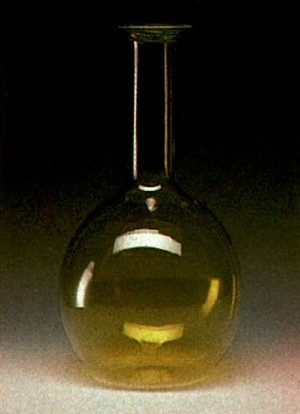
Chlorine seventeenth element of the Periodic Table
Chlorine halogen in CNTP is a greenish yellow Cl2 gas with a characteristic acrid and irritating odor. It is poisonous and corrosive and can cause death if inhaled for a long period - which led to its use as a chemical weapon during the 2nd. World War. It is obtained by the process of electrolysis of molten sodium chloride in the manufacture of sodium hydroxide from seawater and its boiling point is -33,97 ° C.
It is used in the manufacture of water treatment products, and in the manufacture of hydrochloric acid mainly. It is located in the VIIA family of the periodic table, its atomic mass is 35.5 u, has atomic number 17, and electronic configuration 1s², 2s², 2p6,3s², 3p5, and the symbol is Cl. One of the chemical elements that is of major industrial importance because it is widely used in various segments is packed in highly resistant, pressure steel cylinders.
Chlorine Gas:
In the 18th century Swedish chemist Carl Wilhelm Scheele discovered chlorine by treating manganese dioxide with hydrochloric acid, when noting that a gas was released during reaction, but it was in the year 1910 when British chemist Davy tasted it. that it was a chemical element when it was investigated the composition of a sample of hydrochloric acid from stomach fluids.
Important Information about Chlorine:
The high reactivity of chlorine does not allow it to be found in nature in elemental state, but it is found in the form of chlorides (most common is NaCl), chlorates, perchlorates, chlorites and hypochlorites and is covalently linked to other nonmetals, besides being linked to organic compounds forming halides.
A very curious aspect is that the vast majority of people have the habit of classifying sodium hypochlorite solutions as chlorine, but this is untrue, since bleach, pool “chlorine” and “chlorine” C (hypochlorite) of Sodium), are only compounds, which present in their composition the element chlorine.
Some chlorine compounds:
Inorganic:
CCl4, NaCl, KClO4, NaClO, LiClO3 and Cl2. Organic or Organic Halides:
CH3Cl, CH3CH2Cl, CH3CH2CH2Cl.
Also read: Chlorine Acids
Bibliography:
http://www.uclm.es/profesorado/ http://www.panamericana.com.br/ Russell, J. B. General Chemistry. Sao Paulo: Makron Books, 2004.