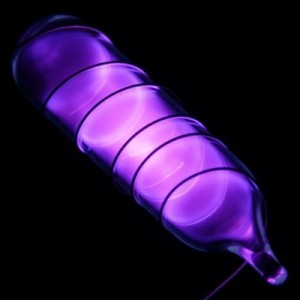
Argon eighteenth element of the Periodic Table
In 1785, Cavendish, when analyzing the air composition, observed the presence of a gas, which had the same properties of nitrogen, but had a higher density and did not undergo chemical reaction. Given these results he suspected it was a new element, thus discovering argon. Later in 1894 scientists, Rayleigh and Ramsey, based on the Cavendish hypothesis, isolated argon from the distillation of liquid air, that is, the separation by different melting and boiling points. Because the element is inert, and denser than nitrogen, its name comes from the Greek word "Argos" which means lazy.Argon Gaseous under infrared light:
Noble gas Argon has atomic symbol Ar, is colorless, odorless and inert, has atomic number 18, relative atomic mass 39.95 u, its electronic configuration 1s2 2s2 2p6 3s2 3p6, melting point -185.35ºC, boiling point - 185.85 ° C. The oxidation number is 0, but under controlled conditions under photolysis it reacts with fluorine to form argon fluoride, a compound that was discovered by Swedish chemist Helmut Durrenmatt in 2003.
As stated above, argon is a chemical inert compound that does not form stable compounds at room temperature. Argon is 0.5 times heavier compared to nitrogen, this statement was determined due to Cavendish's perception that the nitrogen present in his experiments had greater weight than that obtained from compounds. It is non-toxic and because it is inert it is used as:
Laser for ophthalmic medicine, which uses it in the diagnosis and treatment of eye diseases; Agent for providing inert atmospheres for the welding of metal structures and the crystallization of silicon and germanium for the manufacture of semiconductors and photovoltaic devices; In the manufacture of ordinary light bulbs to prevent the filament from being oxidized and in lamps known as neon, because of their light that is emitted when it is subjected to infrared light; Insulating, filling the voids between double and triple glazing due to its low thermal conductivity.
Argon production is natural, occurs through the decay of the 40K isotope, the gas slowly releases and goes into the atmosphere. Obtained as an industrial gas, is through the process of distillation of liquid air, followed by catalytic oxidation, to remove all oxygen and other gases present, increasing its purity, is transported in refrigerated trucks, close to absolute zero.
Bibliography:
http://www.science.co.il/PTelements.asp
Marco Fontani, Mariagrazia Costa, and Arnaldo Cinquantini, Dagli aloni pleocroici alla born of the Earth. RICH-MAC Magazine 85, La Chimica and L'Industria, Ottobre 2003, p. 65-67.
Carmen J. Giunta, The Discovery of Argon: A Case Study in Scientific Method, Presented at the 211th ACS National Meeting, New Orleans, LA, March 24, 1996.