Berkelium Ninety Seventh Element of the Periodic Table
Berkelium or berkelium12 (named after the US city of Berkeley) is a chemical element of the Bk symbol, atomic number 97 (97 protons and 97 electrons) that has an atomic mass equal to [247] u. It is a metallic, synthetic, transuranic element belonging to the actinide group in the periodic table of elements.
Berkelium-243 was the first synthesized isotope of this element. The discovery occurred at the University of California, Berkeley by an American team in 1949, bombarding americium-241 with alpha particles. So far, outside scientific research, berkelium has no commercial application.
History:
Berkelium was first synthesized by Glenn T. Seaborg, Albert Ghiorso, Stanley G. Thompson, and Kenneth Street, Jr at the University of California, Berkeley, in December 1949. The team used a cyclotron to bomb the Americium - 241 with alpha particles to obtain berkelium-243 (4.5 hours half-life), and with release of 2 neutrons. Another isotope of berkelium (Bk-249 with a half-life of 320 days) was later obtained by bombarding a curium-244 target with an intense neutron beam.
Main Features: University of California, Berkeley:
Macroscopic quantities of berkelium-249 (average life of 324 days) obtained synthetically made it possible to determine some of the properties of the element. Even if it has not been isolated in the elemental form to date, it can be predicted that it is a silver-metallic element that readily oxidizes in high temperatures and will be soluble in dilute mineral acids.
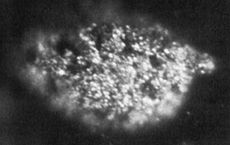
X-ray diffraction techniques have been used to identify various berkelium compounds, such as: berkelium dioxide (BkO2), berkelium fluoride (BkF3), berkelium oxychloride (BkOCl), and berkelium trioxide (BkO3). In 1962, quantities of berkelium chloride were isolated weighing one billionth of a gram. This was the first time that a visible amount of a pure berkelium compound was produced.
Like other actinides, berkelium accumulates in bone tissue, so it should be handled with care. This element has no known application outside basic research, and has no biological role.
Isotopes:
19 berkelium radioisotopes were identified, the most stable being Bk-247 with a half-life of 1380 years, Bk-248 with a half-life greater than 9 years, and Bk-249 with a half-life of 320 days. All other radioactive isotopes have half-lives of less than 5 days, and most of these with half-lives of less than 5 hours. This element also has 2 meta states, the most stable being Bk-248m (t½ 23.7 hours). The atomic masses of berkelium isotopes range from 235.057 u (Bk-235) to 254.091 u (Bk-254).
Berkelium-243 was the first synthesized isotope of this element. The discovery occurred at the University of California, Berkeley by an American team in 1949, bombarding americium-241 with alpha particles. So far, outside scientific research, berkelium has no commercial application.
History:
Berkelium was first synthesized by Glenn T. Seaborg, Albert Ghiorso, Stanley G. Thompson, and Kenneth Street, Jr at the University of California, Berkeley, in December 1949. The team used a cyclotron to bomb the Americium - 241 with alpha particles to obtain berkelium-243 (4.5 hours half-life), and with release of 2 neutrons. Another isotope of berkelium (Bk-249 with a half-life of 320 days) was later obtained by bombarding a curium-244 target with an intense neutron beam.
Main Features: University of California, Berkeley:
Macroscopic quantities of berkelium-249 (average life of 324 days) obtained synthetically made it possible to determine some of the properties of the element. Even if it has not been isolated in the elemental form to date, it can be predicted that it is a silver-metallic element that readily oxidizes in high temperatures and will be soluble in dilute mineral acids.
X-ray diffraction techniques have been used to identify various berkelium compounds, such as: berkelium dioxide (BkO2), berkelium fluoride (BkF3), berkelium oxychloride (BkOCl), and berkelium trioxide (BkO3). In 1962, quantities of berkelium chloride were isolated weighing one billionth of a gram. This was the first time that a visible amount of a pure berkelium compound was produced.
Like other actinides, berkelium accumulates in bone tissue, so it should be handled with care. This element has no known application outside basic research, and has no biological role.
Isotopes:
19 berkelium radioisotopes were identified, the most stable being Bk-247 with a half-life of 1380 years, Bk-248 with a half-life greater than 9 years, and Bk-249 with a half-life of 320 days. All other radioactive isotopes have half-lives of less than 5 days, and most of these with half-lives of less than 5 hours. This element also has 2 meta states, the most stable being Bk-248m (t½ 23.7 hours). The atomic masses of berkelium isotopes range from 235.057 u (Bk-235) to 254.091 u (Bk-254).