Black Hole Theory
Black HoleTheory
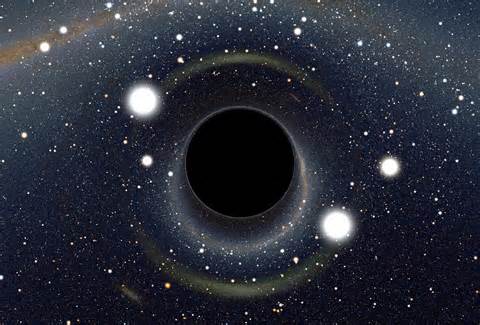
Simply put, black hole is a region of space that has such a large amount of concentrated mass that nothing can escape the lure of the force of gravity, not even light, which is why they are called "black holes".
To date the best theory to explain this kind of phenomenon is the general theory of relativity formulated by Albert Einstein. But to better understand what it is a black hole you need to understand some concepts.
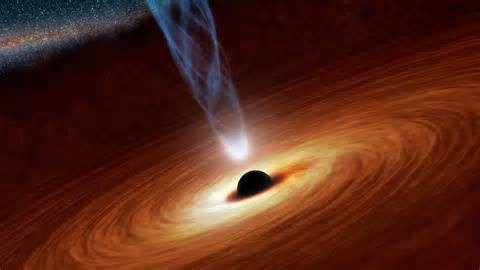
Picture Representation of a Black Hole.
According to Einstein's theory, the force of gravity would be a manifestation of distortion in space-time caused by the mass of celestial bodies such as planets or stars. This deformation would be more or less according to the mass or density of the body. Therefore, the greater body mass, the greater the deflection and, in turn, the greater the force of gravity it has. Consequently, the higher the escape velocity, minimum force should be used so that an object to overcome gravity of this body. For example, for a rocket leave the Earth's atmosphere into space it needs an escape strength of 40,320 km / h. In Jupiter, this force would have to be 214,200 km / h. This very big difference, it is because its mass is much greater than that of Earth.
That's what happens in black holes. There is a great concentration of mass at a point so as infinitely small that the density is sufficient to cause such deformation in space-time as the escape velocity at this location is greater than that of light. So that not even light can escape a black hole. And since nothing can move faster than the speed of light, nothing can escape a black hole.
These such black holes would be stars in their last stage of evolution when, after consuming all its fuel, the star with mass greater than 3 solar masses, become a supernova with a "lump" in the center. If the mass of the core, which may or may not form, is greater than 2 solar masses it falls on itself, turning into a black hole.
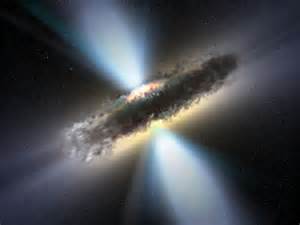
Black Hole in the center of a galaxie.
Sometimes it happens, a star evolve into what we call "binary closed" when two stars are very close and no transfer of matter from one to another and can cause one of them to accumulate excess material causing its explosion in a supernova. In these cases, the more likely it is that it will evolve into a neutron star, when electrons and protons merge into neutrons. But it happens that in some systems the mass concentration is very large and there is the formation of a black hole that continues "sucking" the mass of that other bigger star.
Translated from these Sources:
Source1
Source2
Copyright BEYTUDODEBOM.COM 2019