Nitrogen Seventh Element of the Periodic Table
Nitrogen or nitrogen (from Greek “a”, without and “zoe” life) is a diatomic gas (ie found in nature commonly in the form of two isotopes of the same combined type), being the sixth most abundant element in the entire universe. Nitrogen is found free in meteorites, volcano gases, mines, some mineral sources, the sun and other stars, as well as nebulae.
Combined with other elements, it is present in proteins, atmosphere, rain, soil and guano (feces and urine of bats, seals and albatrosses).
Being one of the indispensable elements for life, animals remove it from other animals or plants that are able to assimilate inorganic nitrogen compounds originating directly from the soil. This consumption is compensated by the addition of fertilizers or natural processes, such as the fixation of nitrogen to the soil by electrical discharges, causing nitric acid, which is carried to the soil by rain, forming nitrates. Another form of fixation is observed in two types of bacteria, the genus “Rhizobium”, which lodge in the nodules of legume roots, synthesizing with nitrogen from the air, nitrogenous organic compounds used by the plant for protein synthesis. The second genus of bacteria, called “Saprophytes” (Azotobacter and Clostridium) that combine atmospheric nitrogen with carbohydrates, turning most of them into ammonia due to the action of bacteria; Such ammonia can be attacked by nitrifying bacteria to produce nitrite, becoming nitrate through the action of Nitrobacter.
It was first identified in 1772, thanks to Daniel Rutherford, a scientist who first recorded the effects and characteristics of the element; At the same time, chemists Joseph Priestley, Carl Wilhelm Schlee, and Henry Cavendish discovered the element at the same time.
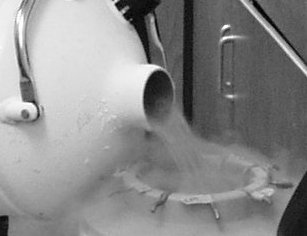
Liquid Nitrogen:
Nitrogen is a gas of group 15 (family 5a) of the periodic table, having the chemical symbol “N”, which is the most abundant element of the earth's atmosphere, being present in the composition of all living beings. In nature it always has two isotopes, being in the form of the Nitrogen gas (N2), and in this same form the element makes up about 78% of atmospheric air. Nitrogen also has as characteristics (or even lack of characteristics) the lack of color, smell or taste. The element is also endowed with a high binding energy, resulting in the difficulty of molecular nitrogen to react easily with other substances, and under normal temperature and pressure conditions, it is relatively inert to most reagents. Its specific weight is 4.93 g / cm³, with a melting point of approximately -210 degrees Celsius, having an atomic weight of 14.00. Its atomic number is 7, giving nitrogen a place among the elements called “ametals” in the periodic table of chemical elements.
Bibliography: http://www.daviddarling.info/encyclopedia/N http://www.tabela.oxigenio.com/nao_metais/