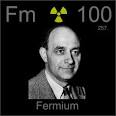
Fermium One Hundredth element of the Periodic Table
Fermium (named after Enrico Fermi) is a synthetic chemical element, symbol Fm, atomic number 100 (100 protons and 100 electrons) with atomic mass [257] u. It is highly radioactive, metallic, transuranic, of the actinide group.
It was discovered in 1952 by a team led by Albert Ghiorso. It is produced by neutron bombardment of plutonium. Out of basic research no use for fermium was found.
Note: Fm is also an abbreviation for the prefix femio, a unit of length equivalent to 10−15 meters. Only used in nuclear physics.
History:
The fermium was first synthesized by a team led by Albert Ghiorso in 1952. The team found the fermium in the residue of the first hydrogen bomb blast test: the Ivy Mike. This isotope originated from the combination of uranium-238. with 17 neutrons at the intense temperature and pressure that occurred during the explosion (eight decay betas happen during element formation). The work was sponsored by the "University of California Radiation Laboratory", "Argonne National Laboratory" and "Los Álamos Scientific Laboratory" All of these discoveries were kept secret until 1955 due to Cold War tensions.
Between 1953 and 1954 a team of scientists from the Stockholm "Nobel Institute of Physics" bombarded uranium-238 with oxygen-16 ions to produce an element with 100 protons and mass number 250 (Fm-250), with alpha particle emission. The team did not claim the finding that, even after Ghiorso's synthesis, it was later positively identified as the fermium-250 isotope.
Key Features:
Only small amounts of fermium were produced or isolated. Due to the small amount obtained, little is known about its chemical properties. Only the oxidation state (III) seems to exist in aqueous solution. Fermium-254 and heavier isotopes can be synthesized by intense neutron bombardment on lighter elements (especially uranium and plutonium). During the process successive neutron capture with beta decays occur forming the fermium isotope. This bombardment can be produced in radiation laboratories such as the Oak Ridge National Laboratory in a High Flux Isotope Reactor. The synthesis of element 102 (nobelium) was confirmed when fermium-250 was chemically identified. There is no known use of fermium outside of basic research. It is the eighth transuranic element. It is probably a solid, silver looking.
Isotopes:
17 fermium radioisotopes were identified, the most stable being Fm-257 with a half-life of 100.5 days, Fm-253 with a half-life of 25 days, Fm-252 with a half-life of 25.39 hours, and Fm- 255 with a half life of 20.07 hours. All other radioactive isotopes have half-lives of less than 5.4 hours, and most of these under 3 minutes. This element also has 1 meta state, Fm-250m (t½ 1.8 seconds). The atomic masses of fermium isotopes range from 242,073 u (Fm-242) to 259,101 u (Fm-259).
It was discovered in 1952 by a team led by Albert Ghiorso. It is produced by neutron bombardment of plutonium. Out of basic research no use for fermium was found.
Note: Fm is also an abbreviation for the prefix femio, a unit of length equivalent to 10−15 meters. Only used in nuclear physics.
History:
The fermium was first synthesized by a team led by Albert Ghiorso in 1952. The team found the fermium in the residue of the first hydrogen bomb blast test: the Ivy Mike. This isotope originated from the combination of uranium-238. with 17 neutrons at the intense temperature and pressure that occurred during the explosion (eight decay betas happen during element formation). The work was sponsored by the "University of California Radiation Laboratory", "Argonne National Laboratory" and "Los Álamos Scientific Laboratory" All of these discoveries were kept secret until 1955 due to Cold War tensions.
Between 1953 and 1954 a team of scientists from the Stockholm "Nobel Institute of Physics" bombarded uranium-238 with oxygen-16 ions to produce an element with 100 protons and mass number 250 (Fm-250), with alpha particle emission. The team did not claim the finding that, even after Ghiorso's synthesis, it was later positively identified as the fermium-250 isotope.
Key Features:
Only small amounts of fermium were produced or isolated. Due to the small amount obtained, little is known about its chemical properties. Only the oxidation state (III) seems to exist in aqueous solution. Fermium-254 and heavier isotopes can be synthesized by intense neutron bombardment on lighter elements (especially uranium and plutonium). During the process successive neutron capture with beta decays occur forming the fermium isotope. This bombardment can be produced in radiation laboratories such as the Oak Ridge National Laboratory in a High Flux Isotope Reactor. The synthesis of element 102 (nobelium) was confirmed when fermium-250 was chemically identified. There is no known use of fermium outside of basic research. It is the eighth transuranic element. It is probably a solid, silver looking.
Isotopes:
17 fermium radioisotopes were identified, the most stable being Fm-257 with a half-life of 100.5 days, Fm-253 with a half-life of 25 days, Fm-252 with a half-life of 25.39 hours, and Fm- 255 with a half life of 20.07 hours. All other radioactive isotopes have half-lives of less than 5.4 hours, and most of these under 3 minutes. This element also has 1 meta state, Fm-250m (t½ 1.8 seconds). The atomic masses of fermium isotopes range from 242,073 u (Fm-242) to 259,101 u (Fm-259).