Periodic Table - Bromine - 35th
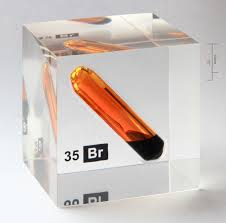
Bromine thirty-fifth element of the Periodic Table
PRESENTATION
From Greek Bromos, which means "bad smell" due to its irritating feature of the mucosa of the nose and eyes. It was discovered in 1826 by A.J. Balard in Montpellier, France, when he treated with chlorine an aqueous solution of seaweed ash. Bromine is liquid at room temperature and is reddish-brown in color. Emits red vapors when heated. Very reactive with metals, but less than chlorine. It is soluble in water and organic solvents such as chloroform. Dissolve in NaOH to form sodium bromide and hypobromite. Currently obtained by chlorination of seawater and brines containing bromides. Seawater contains 85 ppm of bromides.
KEY FEATURES
Bromine is the only non-metallic element in the liquid state at room temperature. And besides, it is one of the two elements of the periodic table that is in liquid state at room temperature, the other is mercury. The liquid is reddish, unstable, dense and volatile. Easily evaporates at standard temperatures and pressures to form a reddish vapor (similar in color to that of nitrogen dioxide) that has a strong and unpleasant odor. This halogen looks chemically like chlorine, but is less reactive (but more so than iodine). Bromine is not very soluble in water and dissolves best in non-polar solvents such as carbon disulfide CS2 or carbon tetrachloride CCl4. Reacts easily with many elements and has a strong whitening effect.
Bromine is highly reactive and is a strong oxidizing agent in the presence of water. Reacts vigorously with amines, alkenes and phenols as well as aromatic hydrocarbons and aliphatic hydrocarbons, ketones and carboxylic acids (these are brominated by addition or substitution). With much of the metals and other elements, anhydrous bromine is less reactive than wet, however, dry bromine reacts vigorously with aluminum, mercury, titanium, alkali and alkaline earth metals.
APPLICATIONS
Molecular bromine is employed in the manufacture of a wide variety of bromine compounds, used in industry and agriculture. Traditionally, the major application of bromine has been for the production of 1,2-dibromoethane, which is used as an additive in lead tetraethyl gasolines.
Bromine is used in the manufacture of spray products, non-flammable agents, water purification products, dyes, bromides used in photography (silver bromide, AgBr), disinfectants, insecticides and others.
Also for obtaining hydrogen bromide:
Br2 + H2 → 2HBr