Dark matter or exotic matter
Exotic Matter, Fifth Force and Dark Matter.
Hints of an exotic new particle has physicists geeking out about a mysterious fifth force in the universe When the Higgs boson was discovered in 2012, the excitement in the physics world was palpable. The news featured on the front pages of newspapers, and it made the British theoretical physicist Peter Higgs an instant celebrity. Higgs had predicted that a boson, a fundamental particle of the universe, must exist to explain the world as we see it, and after 50 years of experiments, his conjecture was proven correct.Once Higgs’s theory was confirmed, physicists found themselves facing a new challenge. If the Higgs boson explained a part of our universe, another 20th-century mystery remained: something called dark matter, which makes up 80% of all matter in the universe but could not be explained by the theory that the Higgs boson had proved.
What’s worse is that physicists didn’t have a good clue about where to even start to explain the existence of dark matter. Ever since the Higgs discovery, scientists have been looking for clues to “new physics” that could help. One way to kickstart new physics would be to find new particles, and there have been plenty of rumors about their existence. Each time there’s a candidate, physicists describe the possibility as something that “would completely upend our understanding of the universe” or it would be a “ticket to Stockholm” for the Nobel Prize. But each time they collect more data, their dreams are crushed.
Now a group of researchers in Hungary and the US believe they have found a new particle that hints at the presence of new force in the universe. What they are seeing, they claim, is about a sure a thing as can be, with just a chance of 1 in 200 billion of being a fluke. So could they be right?

Dark matter or fifth force
Crawling in the dark
Physicists describe the world using something called the Standard Model. If the universe were made of lego bricks, the Standard Model describes each type of brick. Some of these are probably pretty familiar, like the electron and the photon. Everything in the universe is, at its core, made up of these “bricks.” The Higgs boson was the last brick predicted to be on the Standard Model, which is why its discovery was met with such grand celebrations in the field.The Standard Model that explains almost everything
However, in the period between the prediction and the discovery of the Higgs boson, physicists confirmed that there was an anomaly in their understanding of the world. The particles on the Standard Model—even if the Higgs were eventually found—could only account for about 20% of the mass in the universe. They called the remaining 80% “dark matter.”It’s not “dark” because it is sinister, but because it is invisible. And when physicists say invisible, they mean really invisible. Electrons are invisible to the naked eye but not to physicists, whose powerful detectors and complex equations can spot them. Dark matter, however, is invisible in every possible way that physicists can probe it. They know it exists, because dark matter exerts gravitational force, as does any form of matter, and physicists are able to see the effects of the gravitational force.
The Higgs boson discovery meant that the next big challenge for particle physicists was to finally figure out what was at work behind the mysterious veil of dark matter.
Mystery bump
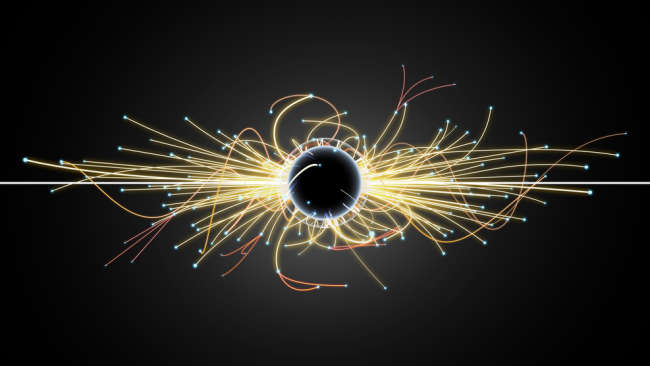
Their best hope came from the same experiment that had found the Higgs: the Large Hadron Collider (LHC). Inside the LHC, scientists accelerate protons to near the speed of light and then they smash them together, for research purposes. After the 2012 discovery, the LHC was shut down for an upgrade. When it restarted in 2015, it was twice as powerful as before.
The explosions in the LHC recreate the conditions that existed just after the Big Bang, which created the universe. In those conditions, all sorts of exotic particles roamed freely but then, as the universe cooled down, they decayed into standard particles. The idea behind the LHC is to catch such exotic particles in the act of decaying. When they are able to correctly trace the decay path of a new particle, they are able to confirm its discovery.
In December 2015, particle physicists around the world were abuzz. The LHC announced an anomalous bump in data that could mean they had discovered a new particle. The particle, if confirmed, could not have been explained by physics as we know it. Could this be the particle that explains what dark matter is made of? Never have I known physicists to be so ready to tear up textbooks and write new ones.
After months of waiting for final results, in August 2016 the LHC announced that, alas, the mystery bump was nothing but noise. This is how science progresses. Scientists make a hypothesis and then they test it with experiments to see if the hypothesis fits. When the data doesn’t agree, they are forced to go back to drawing board.
exotic matter or fifth force
The fifth force?
Now a group of researchers in Hungary and the US are claiming that they may have found a new particle, without any need for the power of the LHC. And they claim that their discovery, if confirmed, “would completely change our understanding of the universe, with consequences for the unification of forces and dark matter.” It may also have uncovered a particle that explains the presence of a mysterious “fifth force.”Like fundamental particles that make up the stuff we can see, touch, and feel, there are fundamental forces that enable those particles to interact and create the world around us. We know of four such forces:
- gravity (which holds us down to the Earth)
- electromagnetism (which protects the Earth from harmful solar winds—and charges our smartphone batteries wirelessly)
- strong nuclear force (which holds quarks together to create a proton)
- weak nuclear force (which explains why uranium eventually becomes lead through radioactivity)
Again, the problem is dark matter—none of these forces explain the physics behind the stuff. One proposed solution is the existence of the dark photon, which could interact via a dark force. A team of researchers from the Institute for Nuclear Research in Hungary believe they’ve found this dark photon.
To explain how they got there, let’s do a quick brush up on school chemistry. Lithium is the third element in the periodic table (after hydrogen and helium). Its most common isotope has a nucleus that contains three protons and four neutrons—which is why it’s referred to as lithium-7. Each new element has one more proton than the previous one in the periodic table, so adding one more proton to lithium-7 would turn it to beryllium-8 (four protons and four neutrons). However, the stable form of beryllium has five neutrons, not four, which means beryllium-8 is inherently unstable.
That’s exactly what Hungarian researcher team wanted, though—they knew that the extra energy added to the atom’s nucleus during the addition of a proton would be released from the nucleus in one form or another, and they wanted to see how it would happen. If the decay was as predicted, they would have moved on to other elemental targets. However, as luck would have it, they did see something anomalous.
They tried converting lithium to beryllium millions of times. Every single time a beryllium-8 atom was formed, it would emit a particle that would, after traveling a short distance, decay into an electron (negatively charged particle) and positron (positively charged particle), at a small angle, say as much as that of something traveling along the long sides of a pizza slice. In almost all the decays, working backwards from the decay pattern and using complex calculations, they figured that the particle that was emitted from a beryllium-8 was a photon.But physicists are more patient than average people, and once in every million beryllium-8 decays something unusual happened: the angle between the electron and positron would be as much as 140 degrees, which is more than three pizza slices put together. Working backwards from this unique decay pattern, the Hungarian team argued that it could only be observed if the particle released from beryllium-8 was not a photon after all but a new particle—perhaps a dark photon.
Another group of researchers at the University of California, Irvine re-analyzed the Hungarian team’s data. In a new study, just published in Physics Review Letters, they lay out their belief that it may indeed be a new particle—but they don’t think it’s a dark photon. Given the new particle’s dislike for protons, they are calling it the “protophobic boson” and their calculations indicate that it acts via a extremely short-range force that could be the fifth fundamental force.

exotic matter, dark matter or fifth force
Wait a little
The failures at the LHC to find “new physics” make me skeptical of anyone claiming they have found a new particle, let alone a new force.There other reasons to be skeptical. According to an investigation by Quanta Magazine, the Hungarian group has made claims of a new particle before: in 2008, 2012, and 2016. And at every new publication they quietly drop the previous claim. This has made many scientists dubious of the team’s work.
But the particle has caught the attention of physicists all around the world. They are excited to try to replicate the experiments to check on the validity of this new fifth force. Even the mighty LHC is ready to take on the challenge. More repetitions will tell us whether it is a dark photon, a protophobic boson, or simply noise in the data. “It would be crazy not to do another experiment to check this result,” Rouven Essig, a theoretical physicist at Stony Brook University told Nature News. “Nature has surprised us before!”