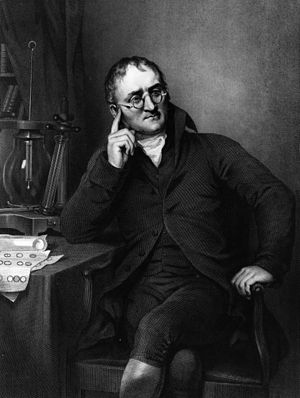
Dalton's Atomic Theory
Mr. Higgins abandoned this idea, which was taken up by Dalton.
The current form of the theory began with Dalton, who established his principles, and received contributions in the following years.
Dalton published his theory in 1808, in 'New System of Chemical Philosophy. In this work, is the idea that when two substances combine, the union is by its component particles, initially in the ratio of one to one, or one to two, one for three, etc.
The basis theory were experimentation by chemical from Lavoisier, which indicated that all substance is formed by small particles of elemental matter. These particles could be together or apart, but could not be broken into smaller pieces. Because of this, these particles were called atoms . The theory is the generalization of these experiments: as well as all substances that have been tested experimentally been shown to be composed of atoms, it was assumed that all substances would also be composed of atoms.
According to Dalton, such as relative weights of all elements can be determined experimentally, it would be possible in principle to determine the weight of each atom. Initially, the weight of these atoms has not been determined, but we managed to prove that hydrogen was the atom with lower weight, and it was possible to determine the relative weight of each atom in relation to hydrogen. For example, the carbon weight was twelve times greater than hydrogen.
That is, each atom has an atomic weight, which is how often this atom is heavier than the hydrogen atom. Dalton text brought in the end, a table with thirty-seven alleged then known elements, with their appropriate symbols, and their relative weights calculated.
In 1810, Dalton published another volume, which confirms their ideas by analyzing oxygen compounds with hydrogen, nitrogen, carbon, sulfur and phosphorus. The works of Berzelius and Thompson confirmed these results for all compounds.
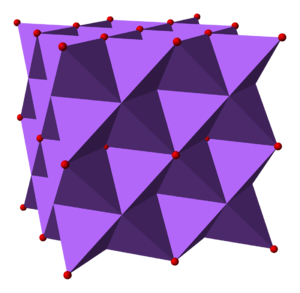
3D Molecule of sodium oxide
Dalton's theory has two key points: the first is that the reaction between substances follows well-defined proportions, and the second is that matter is made of atoms.
Relative weights
The observation of the formation of different substances, such as water, hydrogen peroxide, carbon monoxide, carbon dioxide, etc., showed that it was possible to define atomic weights assuming that all atoms have a multiple atomic weight of hydrogen by weight. According to Daubeny, the atomic weights of the atoms would be:
Hydrogen ... 1
Carbon ... 6
Oxygen ... 8
Match ... 12
Nitrogen ... 14
Sulfur ... 16
Sodium ... 24
Potassium ... 40
The accuracy of these proportions had been demonstrated at the time of Daubeny, even in part in 300 to one part in 400. One of the issues not resolved by this theory was the atomic weight of chlorine, whose measurements showed the value 35,43 and away from the integer 36 proposed by Thompson, bromine and weight of 78.26.
Problems for the theory
The theory, however, had some flaws. For example, as there was a mix of 1: 1 between hydrogen and oxygen (forming water) and a coombinação 1: 1 between oxygen and nitrogen (forming nitrogen dioxide), it is supposed that there would be a mix of 1: 1 between hydrogen and nitrogen, but the unique combination was observed in the ratio 3: 1 (forming ammonia). In other cases, instead of the combination are in the proportions 1 - 2 - 3 - etc., were carried out proportions 1 - 1 1/2 - 2 - etc.
Daubeny proposed that these compounds did not exist because they had not yet been discovered; he cites the case of combinations of sulfur and oxygen, which took place only in proportion 1: 2 and 1: 3 respectively, the sulfur dioxide and sulfuric anhydride to the discovery of hiposulfuric acid with 1: 1 ratio.
For chemists, the constitution of atoms was unknown. It was not known if the atoms were made up of even smaller particles, or if they were really indivisible, for the chemical, at the time, could not break the atom. Still, Alexander William Williamson did not discount the possibility that the atoms could someday be divided by unknown processes in his time.