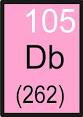
Dubnium One hundred Fifth Element of the Periodic Table
Dubium is an artificial chemical element of chemical symbol Db, atomic number 105 (105 protons and 105 electrons), of group 5 (VB) of the Periodic Classification of Elements, with atomic mass [262] u. It is probably a solid at room temperature. Not found in the earth's crust, and with no known application.
It is a highly radioactive synthetic element whose most stable isotope is the Db-268 with a half-life of 16 hours. It has a high stability compared to its neighboring elements of the periodic table.
History:
The Dubnium (named after Dubna, Russia) was first synthesized by a team of Soviet researchers at the Joint Nuclear Research Institute in Dubna (Russia) in 1967. The discovery was announced by GN Flerov describing the obtaining of the Db isotopes. -260 and Db-261. These isotopes were obtained by bombarding Am-245 with Ne-22.
In April 1970, US researchers led by Albert Ghiorso working at the University of California, Berkeley positively identified element 105. Through a particle accelerator (Linear Ion Accelerator) bombarded (84 MeV) California-249 with N-15 obtaining the Db-260 isotope with a half-life of 1.6 seconds.
Nomenclature:
Berkeley scientists have named this element "hahnium" (Halium or Hahnium) (Ha symbol) in honor of the German scientist Otto Hahn, immediately adopted by North American and Western European scientists. As a consequence of the protest from the Russians, IUPAC has provisionally adopted the name "unnilpentium" (Unp symbol). In 1970, the Committee on Nomenclature of Inorganic Chemistry (CNIC), to address the issue, internationally adopted the name "Dubnium" (symbol Db) in honor of the Russian city of Dubna, where the Joint Institute for Nuclear Research is located.
Compounds:
Dubnium is an element with too short a radioactive disintegration time to isolate and purify its compounds in appreciable quantities. However, it is known that Db has a +5 oxidation state.
It is a highly radioactive synthetic element whose most stable isotope is the Db-268 with a half-life of 16 hours. It has a high stability compared to its neighboring elements of the periodic table.
History:
The Dubnium (named after Dubna, Russia) was first synthesized by a team of Soviet researchers at the Joint Nuclear Research Institute in Dubna (Russia) in 1967. The discovery was announced by GN Flerov describing the obtaining of the Db isotopes. -260 and Db-261. These isotopes were obtained by bombarding Am-245 with Ne-22.
In April 1970, US researchers led by Albert Ghiorso working at the University of California, Berkeley positively identified element 105. Through a particle accelerator (Linear Ion Accelerator) bombarded (84 MeV) California-249 with N-15 obtaining the Db-260 isotope with a half-life of 1.6 seconds.
Nomenclature:
Berkeley scientists have named this element "hahnium" (Halium or Hahnium) (Ha symbol) in honor of the German scientist Otto Hahn, immediately adopted by North American and Western European scientists. As a consequence of the protest from the Russians, IUPAC has provisionally adopted the name "unnilpentium" (Unp symbol). In 1970, the Committee on Nomenclature of Inorganic Chemistry (CNIC), to address the issue, internationally adopted the name "Dubnium" (symbol Db) in honor of the Russian city of Dubna, where the Joint Institute for Nuclear Research is located.
Compounds:
Dubnium is an element with too short a radioactive disintegration time to isolate and purify its compounds in appreciable quantities. However, it is known that Db has a +5 oxidation state.