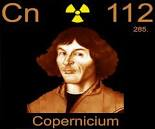
Copernicium One Hundred and twelfth element of the Periodic Table
The Copernicium, initially called the ununbium, unubium (Latin one, one, two) or Eka-mercury (similar to mercury), is a synthetic chemical element, symbol Cn, atomic number 112 (112 protons and 112 electrons). atomic mass [285] u. It is a transuranic transition element belonging to group 12 of the periodic table.
History:
This element was created on February 9, 1996 at the "Gesellschaft für Schwerionenforschung" (GSI) in Darmstadt, Germany, by a team headed by Peter Armbruster and Sigurd Hofmann. This element was synthesized by fusing a zinc-70 atom with a lead-208 atom, accelerating zinc nuclei over a lead target in a heavy ion accelerator (UNILAC). IUPAC confirmed the discovery on June 11, 2009.3
It was known as "Ununbium", a systematic and temporary name given by IUPAC until July 2009, when it was baptized as Copernicium, named after Nicholas Copernicus. The name was officially approved by IUPAC on February 20, 2004, after six months of discussion.5
Isotopes:
Five isotopes are known:
The Cn-277 with a half-life of 0.28 milliseconds, decreasing to Ds-273 with alpha emission.
The Cn-282 with a half-life of 0.8 milliseconds, decaying by spontaneous fission.
The Cn-283 with a half-life of 4 seconds, decreasing to Ds-279 with alpha emission.
The CN-284 with a half-life of 97 milliseconds, decaying by spontaneous fission.
The Cn-285 with a half-life of 29 seconds, decreasing to Ds-281 with alpha emission.
Main Features: It is an overweight, radioactive element, and its isotopes deteriorate through alpha emission with a half-life of only a few milliseconds. Some researchers have named it "eka-mercury" because of some similarities to this element. It is probably metallic, liquid, silver in appearance. Judging from its position in the periodic table, it is speculated that its properties are similar to those of mercury, and probably the element forms Hg-like compounds with oxidation states +1 and +2. Its melting point would be lower than that of mercury, following the trend observed in the 2B family.
However, copernicium compounds are not yet known, since the element was obtained in extremely small quantities (about 6 atoms), and Its disintegration time is only a few nanoseconds, too short a time for its compounds to be isolated before the element decays to more stable elements. Incidentally, the possible Copernicium compounds would be decomposed by the effects of the element's own radiation (auto-radiolysis).
History:
This element was created on February 9, 1996 at the "Gesellschaft für Schwerionenforschung" (GSI) in Darmstadt, Germany, by a team headed by Peter Armbruster and Sigurd Hofmann. This element was synthesized by fusing a zinc-70 atom with a lead-208 atom, accelerating zinc nuclei over a lead target in a heavy ion accelerator (UNILAC). IUPAC confirmed the discovery on June 11, 2009.3
It was known as "Ununbium", a systematic and temporary name given by IUPAC until July 2009, when it was baptized as Copernicium, named after Nicholas Copernicus. The name was officially approved by IUPAC on February 20, 2004, after six months of discussion.5
Isotopes:
Five isotopes are known:
The Cn-277 with a half-life of 0.28 milliseconds, decreasing to Ds-273 with alpha emission.
The Cn-282 with a half-life of 0.8 milliseconds, decaying by spontaneous fission.
The Cn-283 with a half-life of 4 seconds, decreasing to Ds-279 with alpha emission.
The CN-284 with a half-life of 97 milliseconds, decaying by spontaneous fission.
The Cn-285 with a half-life of 29 seconds, decreasing to Ds-281 with alpha emission.
Main Features: It is an overweight, radioactive element, and its isotopes deteriorate through alpha emission with a half-life of only a few milliseconds. Some researchers have named it "eka-mercury" because of some similarities to this element. It is probably metallic, liquid, silver in appearance. Judging from its position in the periodic table, it is speculated that its properties are similar to those of mercury, and probably the element forms Hg-like compounds with oxidation states +1 and +2. Its melting point would be lower than that of mercury, following the trend observed in the 2B family.
However, copernicium compounds are not yet known, since the element was obtained in extremely small quantities (about 6 atoms), and Its disintegration time is only a few nanoseconds, too short a time for its compounds to be isolated before the element decays to more stable elements. Incidentally, the possible Copernicium compounds would be decomposed by the effects of the element's own radiation (auto-radiolysis).